
A recent report by Steve Hilton, former Fox News Host and candidate for governor of California, accused California’s Solar on Multifamily Affordable Housing (SOMAH) program of funneling “$928 million from gas tax and electric bills intended for solar panels for apartment buildings [to] leftist groups.”
SOMAH provides incentives for solar panels on multifamily housing paid for by cap and trade funds. California Governor Newsom’s office has denied that any partisan activity was funded through the program.
Some of those accusations are false. SOMAH couldn’t have given that much to nonprofits since the project hasn’t spent most of the money it’s been allocated yet.
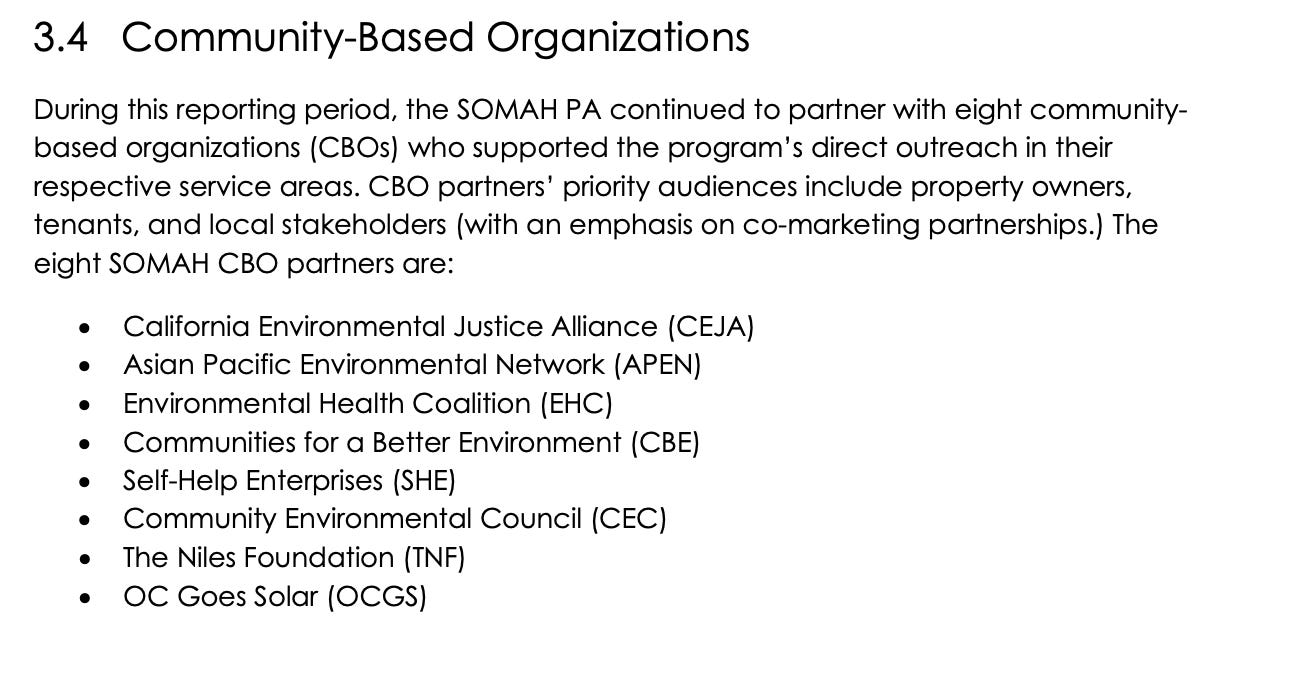
But part of the accusations are true. SOMAH does fund community-based organizations like the California Environmental Justice Alliance (CEJA) and the Environmental Health Coalition (EHC) as part of its marketing budget to promote incentives for rooftop solar. Those groups are often activist organizations also involved in separate get-out-the-vote operations that can walk a thin line between non-partisan philanthropy and partisan political action. For example, besides promoting alternatives to fossil fuels, CEJA lists “[conducting] civic engagement activities to strengthen the [environmental justice] voter bloc across California” as one of their main activities in IRS filings.
Yet totals for community-based marketing in SOMAH’s budget are less than $5.5 million since 2020 on a $1 billion project. It’s a significant amount for funding a nonprofit’s get-out-the-vote campaign, but not a financial drain on a major energy project.
The funding of community organizer groups part of the budget isn’t what’s burdening solar installation. Rather the major financial burden comes from paying out $10 to $15 million a year in rebates to subsidize property owners for solar installations. And rooftop solar is expensive to install.
The Inefficiency of Rooftop Solar
Based on reports, the cost of completed solar panel installations under SOMAH so far is $84 million for 41.942 megawatts of capacity. That works out to $2 million per megawatt of solar capacity.
That’s not too far removed from other common estimates of cost per capacity of solar. The Energy Information Administration (EIA) estimates it at $1,588 per megawatt for all solar types (e.g. utility-scale or rooftop). The Department of Energy estimates an average of over $2.5 million to $3 million.
SOMAH data on individual installations shows a median cost of $560,000 per megawatt just for the panels alone.
But the issue isn’t just the capacity, but the actual amount of energy generated, especially for solar. Solar panels don’t produce energy when the sun isn’t shining, and their actual generation can stray far below their potential capacity, especially for rooftop solar.
Generation numbers for rooftop solar are usually more difficult to come by because of the distributed behind-the-meter nature of rooftop solar. But SOMAH reports for Q1 to Q2 of 2025 give a glimpse behind the meter.
The program tracked 22.9 gigawatt-hours of energy produced in the first half of 2025—45.8 gigawatt-hours annually—based on 39.4 megawatts of capacity. That works out to a solar efficiency rate of 13.2 percent—less than average solar efficiency rates, which hover around 15 to 20 percent.
Efficiency Rate = Total Actual Energy Produced Annually / Total Potential Energy Produced Based on 100% Efficiency = (45,800 megawatt-hours) / (39.4 megawatts x 24 hours x 365 days) = 13.2 percent
If the SOMAH program spent $84 million for 41.942 megawatts of capacity, with an efficiency of 13.2 percent, that works out to a whopping $1,730 per megawatt-hour of actual generation annually, easily one of the most expensive sources of energy, even before including other costs like ongoing maintenance, cost of capital, and replacement costs.
Most levelized costs of energy (LCOE) calculations list utility-scale sources with rates below $100 per megawatt-hour. EIA shows nothing above $200 per megawatt-hour. Department of Energy has a larger scale of estimates that includes lifetime costs, but even that tops out at $600 per megawatt-hour.
While solar is commonly promoted as one of the cheapest energy sources because of declining photovoltaic panel costs subsidized by China, that only applies to utility-scale solar where thousands of panels are installed at scale and panels are attached to motors that track with the sun. Rooftop solar, where solar tracking is rare and installation costs are higher, is substantially more expensive.
$83,912,456 /(41.942 megawatt capacity x 24 x 365 x .132 efficiency) =
$1,730.2112 per megawatt-hour actual generation