The California Public Employees’ Retirement System, or CalPERS, is easily the largest public pension plan in the U.S. with over $556 billion in assets under control.
It is constantly the target of shareholder activism over investment decisions that not only affect the retirement benefits of thousands of state workers, but they set the direction of pension plan investment nationwide.
A recent report funded by the Retired Public Employee's Association of California (RPEA) showed the plan chronically underperforms compared to its peers, especially considering its emphasis on alternate investments like private equity with little disclosure on fees. Other times, it is embattled over its Environmental, Social, and Governance (ESG) investments, and whether those are necessary to save the planet or simply throwing money down the well.
But little gets mentioned about how much CalPERS, and potentially other pension plans, are now paying towards health benefits since the passage of Obamacare.
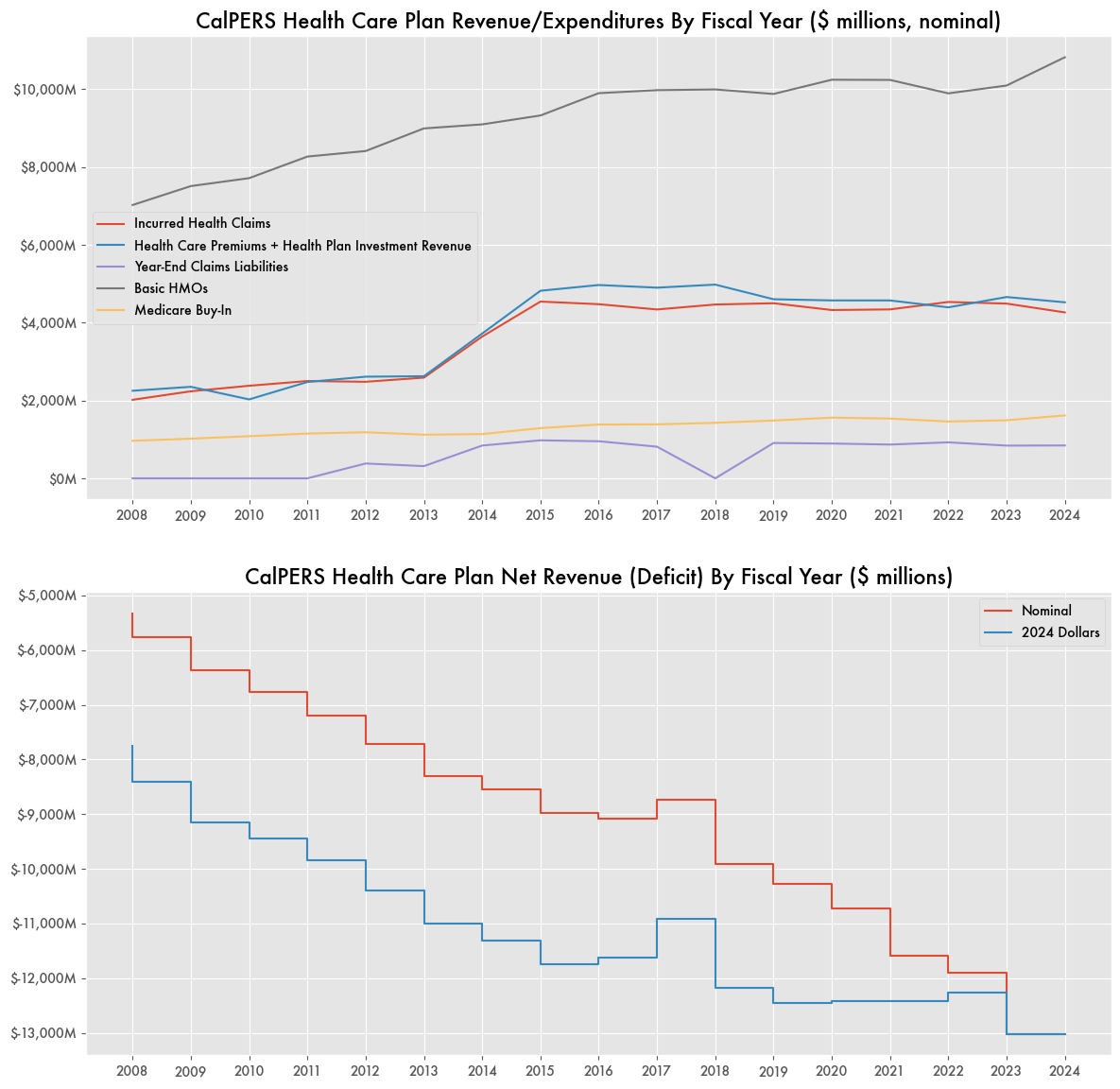
What was once less than $2 billion a year in healthcare claim costs and administrative expenses for CalPERS before 2013 has doubled to become $4 billion and is now over $5 billion a year.
Some of that is related to flex-funding, where the pension fund pays for capitation—a specific set of services like primary care and some fee-for-service healthcare—up to a specified amount. Private insurers handle the rest. While claims spending has gone up, so have the premiums collected by CalPERS to pay for them, and the net balance has not changed all that much.
According to the CalPERS annual financial report, the 39.3 percent growth in claims expenses in fiscal year 2014 to 2015 was largely driven by flex-funded health plan activity and the 81 percent growth in administrative costs came from Affordable Care Act (ACA) tax payments.
Flex-funding was meant to help drive down healthcare costs. Rather than leaning on insurers to keep costs down, the pension fund handles claims and can see and control what claims get approved and for how much. They get to keep any net spending that doesn’t otherwise get used rather than the insurer.
But independent of flex-funding, CalPERS is still throwing billions at private insurers—mainly Health Maintenance Organization (HMO) plans like Kaiser Permanente—and Medicare buy-ins for the other end of healthcare for its members, upwards of $10 billion a year.
In terms of net healthcare spending, between Medicare, HMOs, and flex-fund spending and premiums, CalPERS is likely spending on order of $6 billion more per year in inflation-adjusted dollars than they were in 2008.
It’s a decent chunk of change considering that the pension fund earned $61.4 billion in investment returns in fiscal year 2024-2025.
Not Just More Enrollees
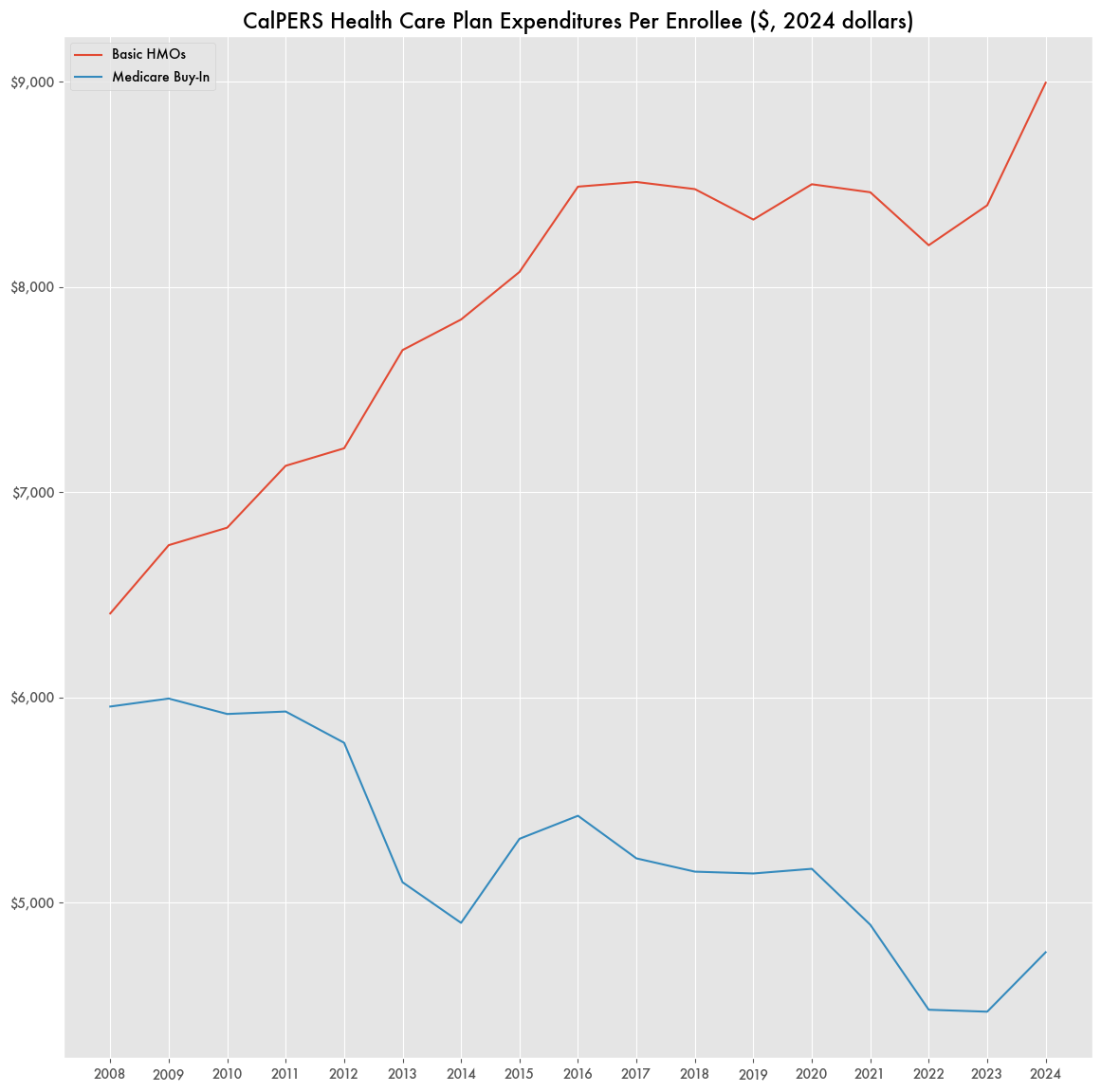
Even when accounting for the growing number of CalPERS healthcare plan enrollees, the spending is growing off the charts. What was once on the order of $6,500 per enrollee on private plans is now about $9,000 in 2024 dollars.
Medicare buy-in spending per enrollee has actually declined in inflation-adjusted dollars, although those plans benefit from government subsidization of Medicare.
While $9,000 for annual insurance might seem cheap considering that family plans can run into the tens of thousands of dollars, that is an average across all enrollees, individuals and families. Plus, large pension funds should pay lower rates on average as they leverage their large populations for discount rates.