Across the United States, energy demand jumped in the last two years with the advent of advanced AI and the sharp growth in data centers that consume large amounts of electricity.
Since 2022, total energy generation has increased 128 terawatt-hours for the first six months of the year (January to June), or about 6 percent. In July, regional transmission operator (RTO) Pennsylvania, New Jersey, and Maryland Interconnection (PJM) recorded some of the highest auction prices for electricity in its history. For some households, that led to a stark increase in electricity costs.
Soon after, Pennsylvania Governor Josh Shapiro sued PJM to cap their auction prices and prevent rate hikes on customers. PJM pointed to the ongoing supply-demand imbalance as the source of high auction prices.
While the increase in demand in AI is substantial, net capacity—total potential energy generation—has been increasing year over year. According to Energy Information Administration (EIA) data, about 69 gigawatts of capacity was added between 2022 and 2024, with a potential additional generation of 604 terawatt-hours per year—more than enough to cover the growth from AI.
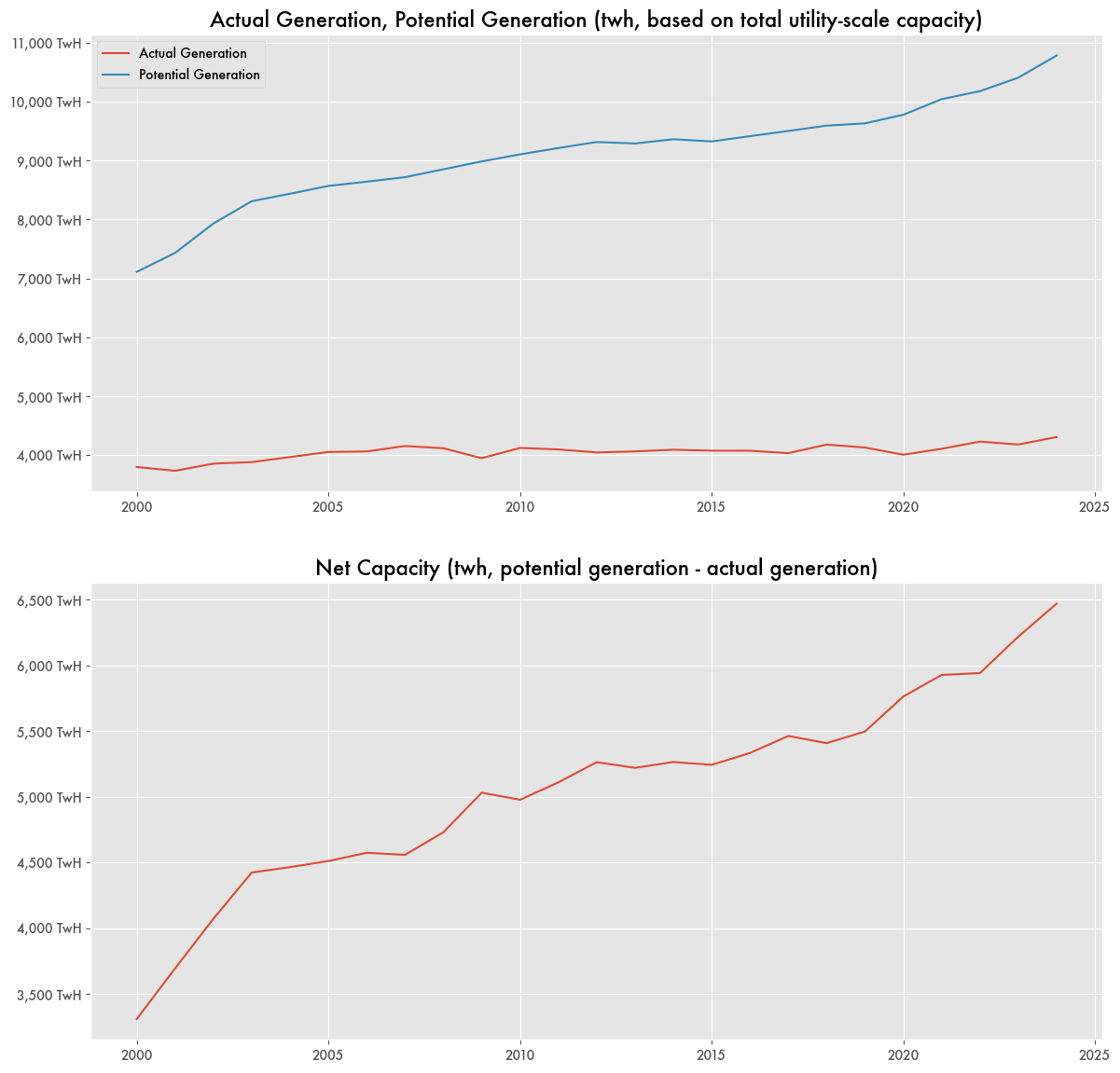
But capacity is sometimes a loose term. It can mean what a coal plant could theoretically deliver if it was run constantly for 24-hours, or it can mean what a solar panel can deliver at peak sunlight.
Those situations are not always possible. Coal plants go offline for repairs. Solar panels can never obtain full sunlight for 24 hours at a time.
For example, China often boasts of its installed solar capacity that easily dwarfs that of its coal generation capacity. But actual generation numbers show that China still gets much more of its energy from coal. China’s massive solar capacity doesn’t equate to massive solar generation. That’s because China’s capacity factor for solar—the ratio of what it actually generates to its theoretical nameplate capacity—can be as low as ten percent. In the U.S., average capacity factor for solar hovers around 20 to 30 percent, depending on where it is installed.
That’s why PJM and other RTOs use an adjusted metric for what is considered actually available capacity, such as unforced capacity (UCAP), which is equal to:
Installed Capacity (ICAP) x (1 - EFORd)
Where EFORd is the Equivalent Demand Forced Outage Rate—the pre-calculated rate at which an energy source is unavailable.
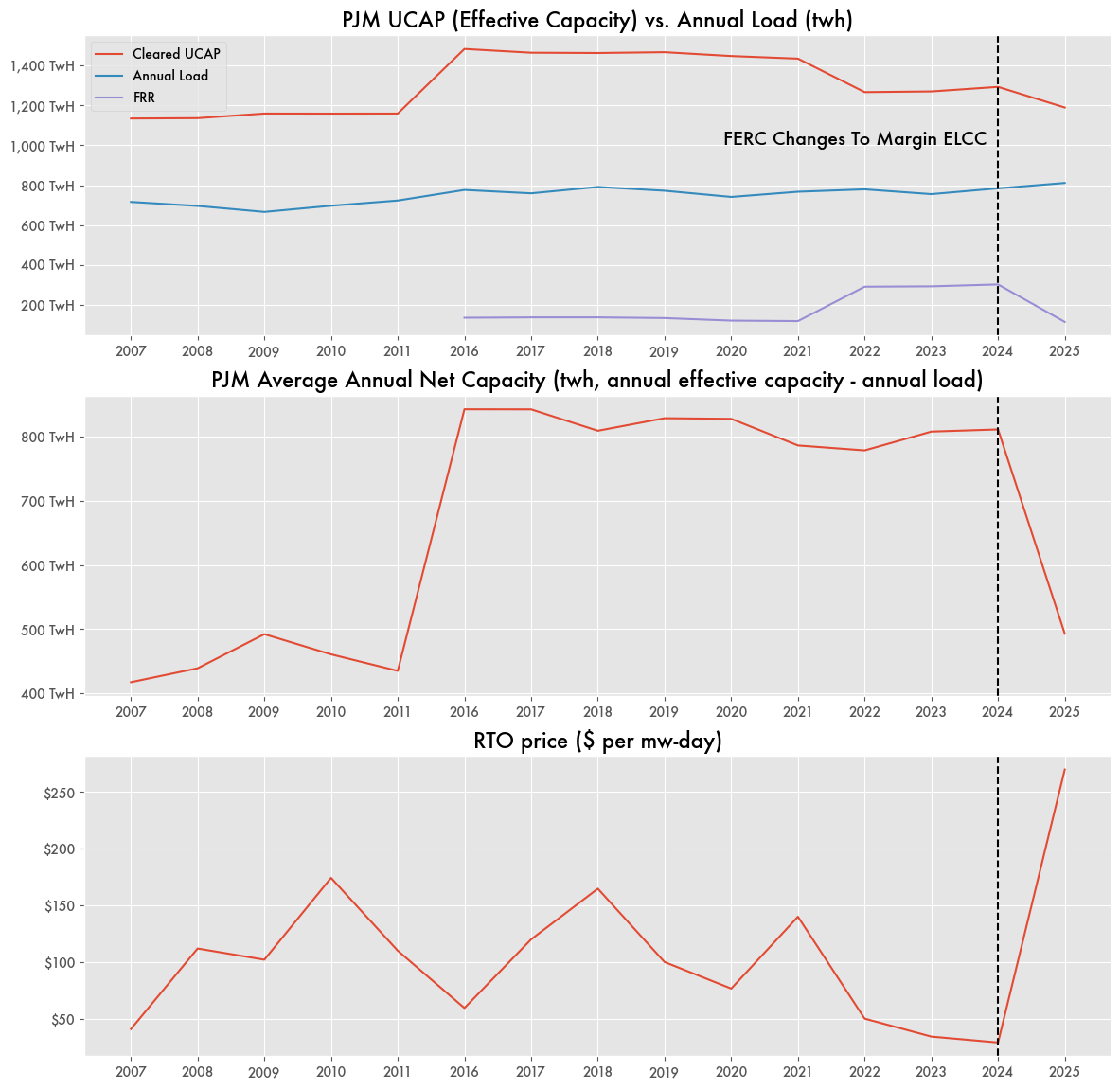
In PJM’s reports they have two measurements of unforced capacity: UCAP, which refers to the adjusted capacity available for market auctions, and Fixed Resource Requirement (FRR)—generation capacity at a fixed price for certain utilities with PJM that choose to not use the auctions for obtaining electricity.
In PJM’s capacity auctions, generators bid to provide capacity—energy that may or may not get used at a time in the future. If the energy is not needed, the generator still gets paid. But if the energy is needed and the generator can’t provide it, they can be penalized through deficiency charges.
In 2022, Dominion Energy of Virginia chose to leave the PJM markets and switch to FRR for their customers. Dominion is also the utility that provides energy generation for Loudon County where the largest collection of data centers resides. But in 2025 they returned to the UCAP markets.
ELCC Changes
In total, PJM’s capacity wasn’t really affected by Dominion leaving the auction and returning. Instead the drop in capacity in 2025 was largely a result of Federal Energy Regulatory Commission’s (FERC) marginal Effective Load Carrying Capability (ELCC) rule in 2024.
In 2022, Winter Storm Elliott almost led to rolling blackouts across the rust belt and exposed the lack of true capacity in energy markets. As a result, FERC reinterpreted how it valued capacity in energy markets to better weigh tight or marginal situations. The final marginal ELCC rule would weigh more resilient forms of energy over others, and some generators would bow out of capacity auctions as a result.
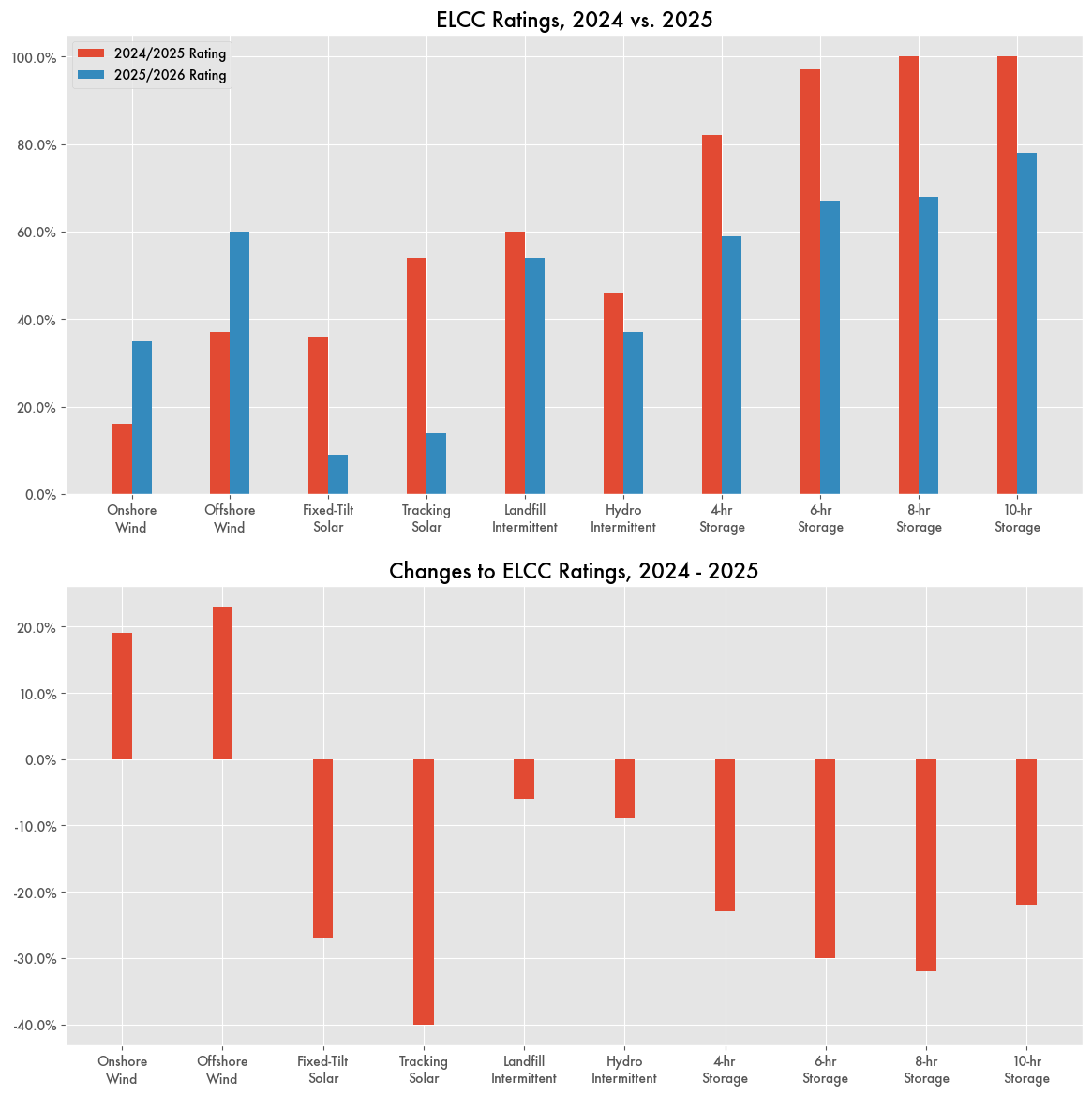
As part of ELCC rules, each generation source gets an ELCC rating that is effectively like a capacity factor—how reliable the source is to generate energy when needed—and the new rules set the ELCC ratings for solar much lower when they were.
With the new changes, tracking solar—solar panels that track the sun’s movements—would have its ELCC rating fall from 54 percent to 14 percent. Fixed-tilt solar would go from 36 percent to 9 percent. Battery storage, which was previously given ratings around 100 percent, would lose 20 to 30 percentage points. Wind would actually have its ratings upgraded for both onshore and offshore turbines.
The lower rates pushed the accredited UCAP much lower and make bidding in the capacity auction less appealing, with somewhere on the order of 34 gigawatts disappearing from the market as a result. The remaining generators can then charge more for the dwindling supply