
Deinstitutionalization of the mentally ill—moving treatment away from full-time inpatient care in mental institutions and sanitariums and towards outpatient care and psychotropic drugs—is commonly referred to as one of the main drivers of crime across the latter half of the 20th century.
Crime in the U.S. grew concurrently as mental institutions were closing down. More patients with schizophrenia were prescribed thorazine rather than committed to an insane asylum as the drug epidemic took over modern cities. Many of them wound up in jail as prisons became de facto mental institutions that were ill equipped to deal with the flood of convicts with psychosis.
But various critics have pointed out a glaring hole in that logic: the vast majority of the institutionalized population were elderly, half of them were female. Those are two populations rarely associated with inner city crime. Mental institutions were more often used as retirement homes for those suffering dementia rather than schizophrenia.
While deinstitutionalization changed sentencing standards, courts sentencing defendants to a mental health asylum through diversion or pleading insanity has always been relatively rare. For those that are, inpatient mental hospitals still exist.
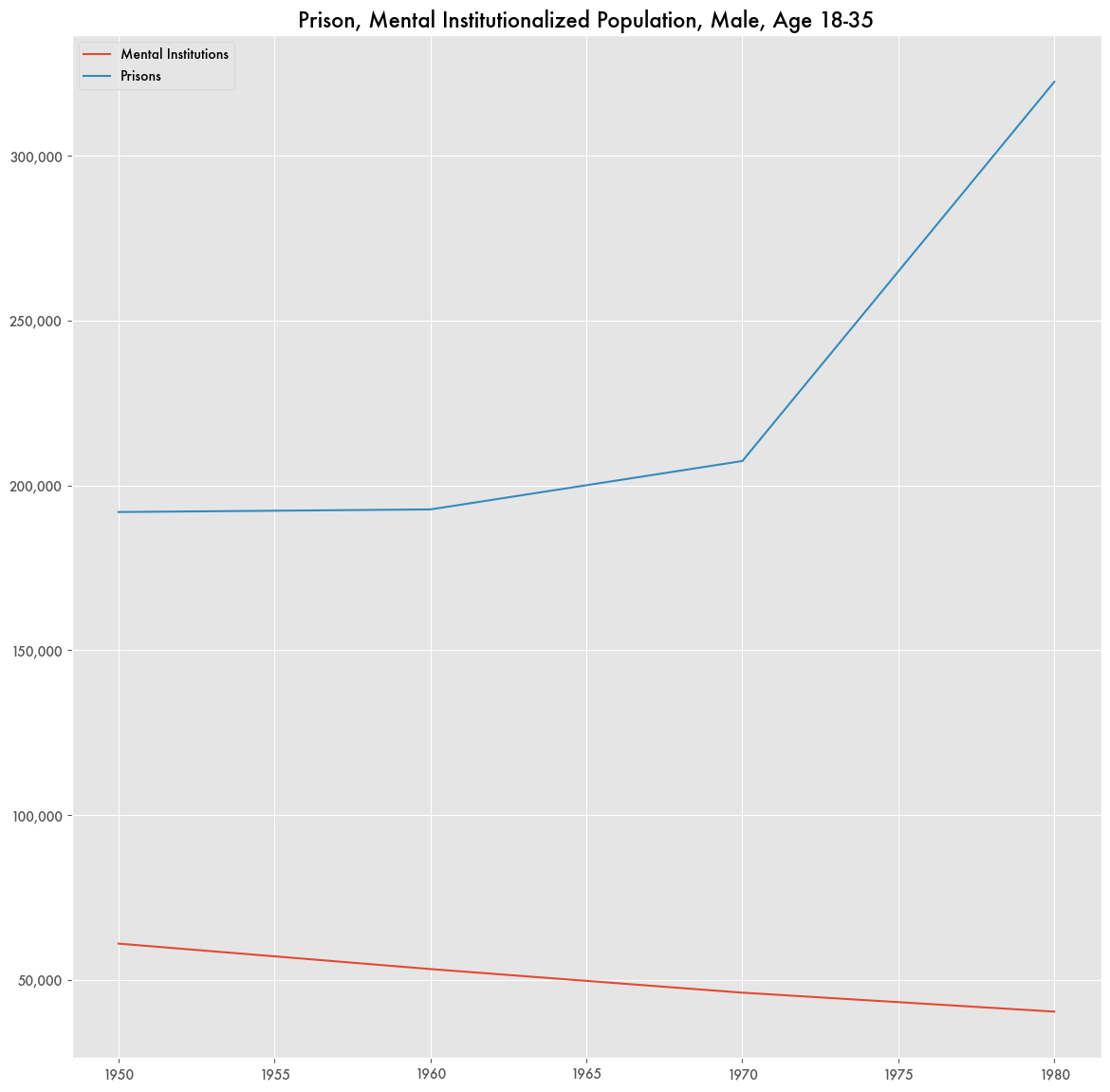
When accounting for age and gender, the inverse correlation between prison rates and mental institution rates is not as glaring. Between 1960 and 1980, the number of men aged 18 to 35—the majority demographic of those in prison—grew by about 130,000 based on Census data. That same demographic cohort for mental institutions declined only by 13,000 for the same period.
That is a sizable difference even if those suffering from severe mental illness in public are significantly more likely to commit crimes and be repeat offenders; potentially a contributing factor but difficult to describe as a main cause of prison overpopulation.
What Defines “Severe”
Additionally, the accusation that prisons were suddenly filled with the severely mentally ill is suspect as the data on mental illness in prisons is spotty at best. Much of it is self-reported on sample populations.
While self-reported data can be useful, it has major biases and definitional issues. What is considered severe is sometimes in the eye of the surveyor and the prisoner being surveyed, and the rates vary wildly from report to report.
On top of that, there are the common difficulties of statistics on psychological conditions. Clinical definitions of conditions like schizophrenia and major depression that make up severe mental illness have consistently changed over time, so even clinical surveys can be vague in historical context. While prisoners are rife with mental health issues, the number that are severe and pre-existing to detainment are hard to pin down.
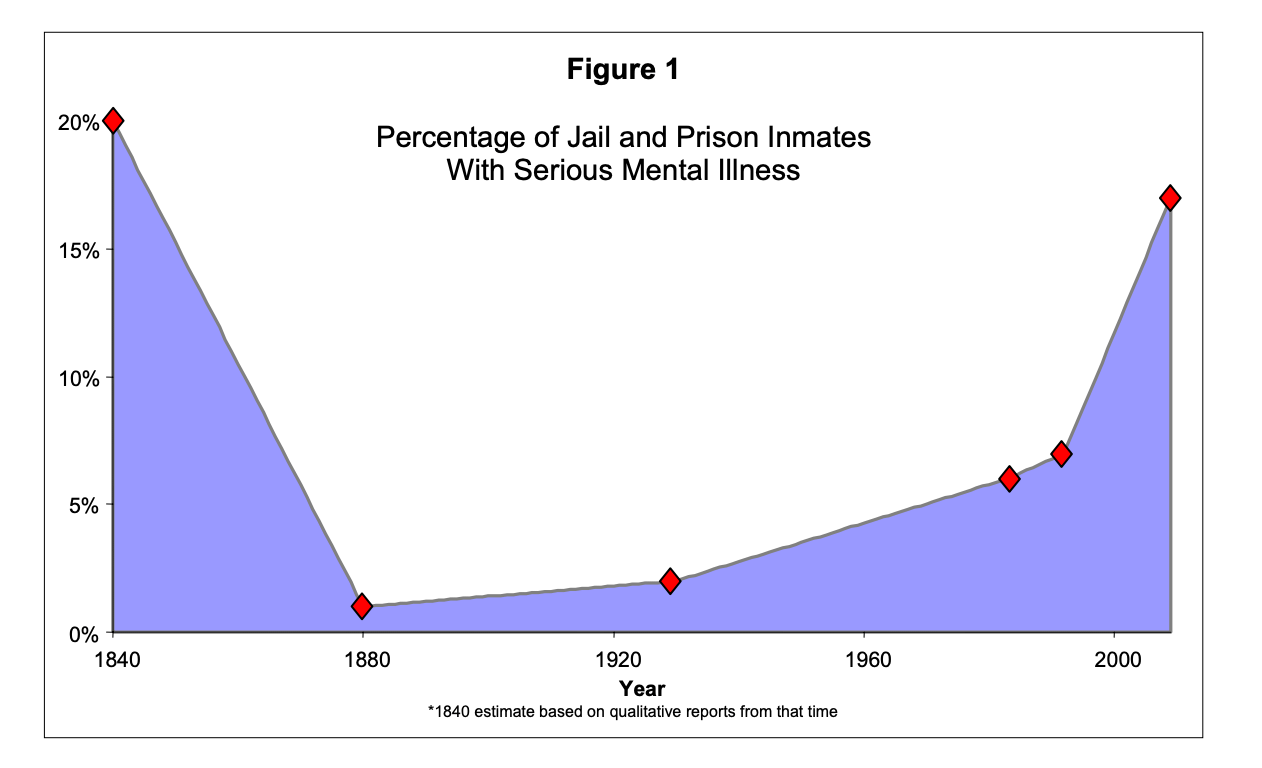
A 2010 paper from researchers for the Treatment Advocacy Center and Sheriff’s Association estimated the percentage of those in jail or prison with a severe mental illness was 1.5 percent in 1930 but now stands at around 16 percent based on BOP reports. Combined with the growth in the total prison population, that would imply an explosion in serious mental illness.
Bureau of Prisons (BOP) data shows a prison population in 1933 at 189,433. With 1.5 percent mentally ill, that would be on the order of 2,850 in total.
For 2016, a 16 percent rate with around 2.2 million incarcerated would mean on the order of 352,000 mentally ill prisoners in total, far beyond what might have come from deinstitutionalization. It would put the growth rate since 1933 at a seemingly implausible 1,220 percent.
Despite coming from a large survey published by the Bureau of Justice Statistics (BJS) in 1999, the data that the 16 percent mentally ill prisoner rate comes from is based on self-reported data of whether a prisoner had a mental condition or an overnight stay in a mental hospital.
Another BJS self-reported survey of inmates in 2005 put the number of mentally ill prisoners between 45 to 64 percent of state, federal, and local jail populations. One BJS report in 2016 estimated 13 percent suffered from recent severe psychological distress.
Yet a more exhaustive, non-self-reported survey with a clinical definition of severe mental illness by the Government Accountability Office (GAO) in 2018 put the estimate at a much lower 4.2 percent of those in federal custody.
Between the 1930s and 1990s there were few exhaustive surveys, self-reported or otherwise. Most data comes from academic research sample surveys of a single prison population, like this study of inmates in Cook County, Chicago from 1983, which estimated a 6.36 rate of any severe disorder. One from 1976 from a county jail put the estimate at 22 to 23 percent, significantly higher than more recent numbers.
Without a consistent definition of “severe mental illness,” there’s no good determiner of how deinstitutionalization affected prisons.
Another example of bogus stats by government which is, too often, not much different than established science organizations. Some are good, some are not, but we usually need the help of independent parties to know which is which.