
Based on the Department of Housing and Urban Development’s (HUD) point-in-time survey, homelessness was in steady decline across the United States from the early 2000s through 2016. That means the explosion in homelessness and tent cities that’s now being seen in places like Los Angeles, Oakland, and Seattle ostensibly happened in the last 10 years.
That doesn’t jibe with numerous anecdotal descriptions of tent cities appearing in cities following the financial crisis in 2008 that ascribe the growth in homelessness to housing affordability and other economic issues. Academic papers were already being written in 2017 about the rise in “tent wards”—large-scale semi-regulated homeless encampments—to deal with the flood of the unhoused showing up in West coast cities.
More so, much of the decline in homelessness that supposedly occurred during that period happened in Florida. The sunshine state went from almost 58,000 homeless— the majority of which were unsheltered, not in a temporary living situation—to 21,000 in less than ten years with no substantive explanation.
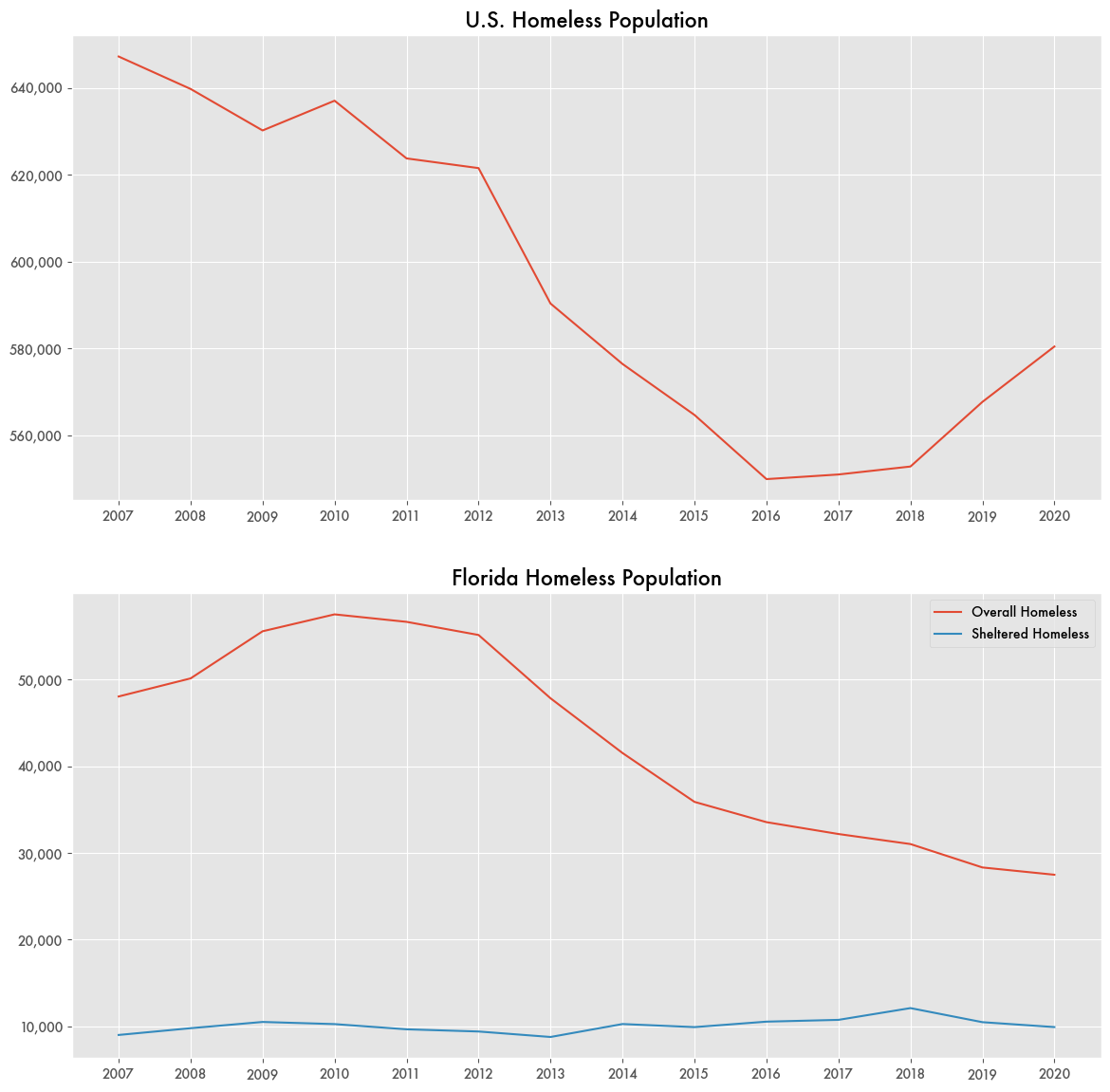
That decline accounted for 40 percent of the national decline over that period. Essentially, Florida, which had a substantial homeless issue for years, suddenly resolved most of the issue with little explanation of how.
Based on a report from the Florida Housing Coalition, it’s because the state’s economy turned around and the government started funding housing initiatives:
First, the economy has improved since 2010. Since homelessness is primarily due to a mismatch between income and housing costs, increasing income and employment opportunities result in decreased homelessness.
Second, the Florida Legislature has increased appropriations to preserve and create affordable housing, including housing for those with special needs and very low incomes. Again, because homelessness results from housing costs that are out-of-reach to those with lower incomes, increasing the stock of affordable housing reduces homelessness.
Third, in recent years Florida communities have embraced evidence-based best practices such as Housing First, collaborative case management, and rapid rehousing. Nationwide, these models have proven successful in decreasing homelessness.
None of those make much sense. To the first point, homelessness had been high prior to the economic collapse when unemployment was relatively low. Total non-farm employment in Florida fell by about a million following the financial crisis.
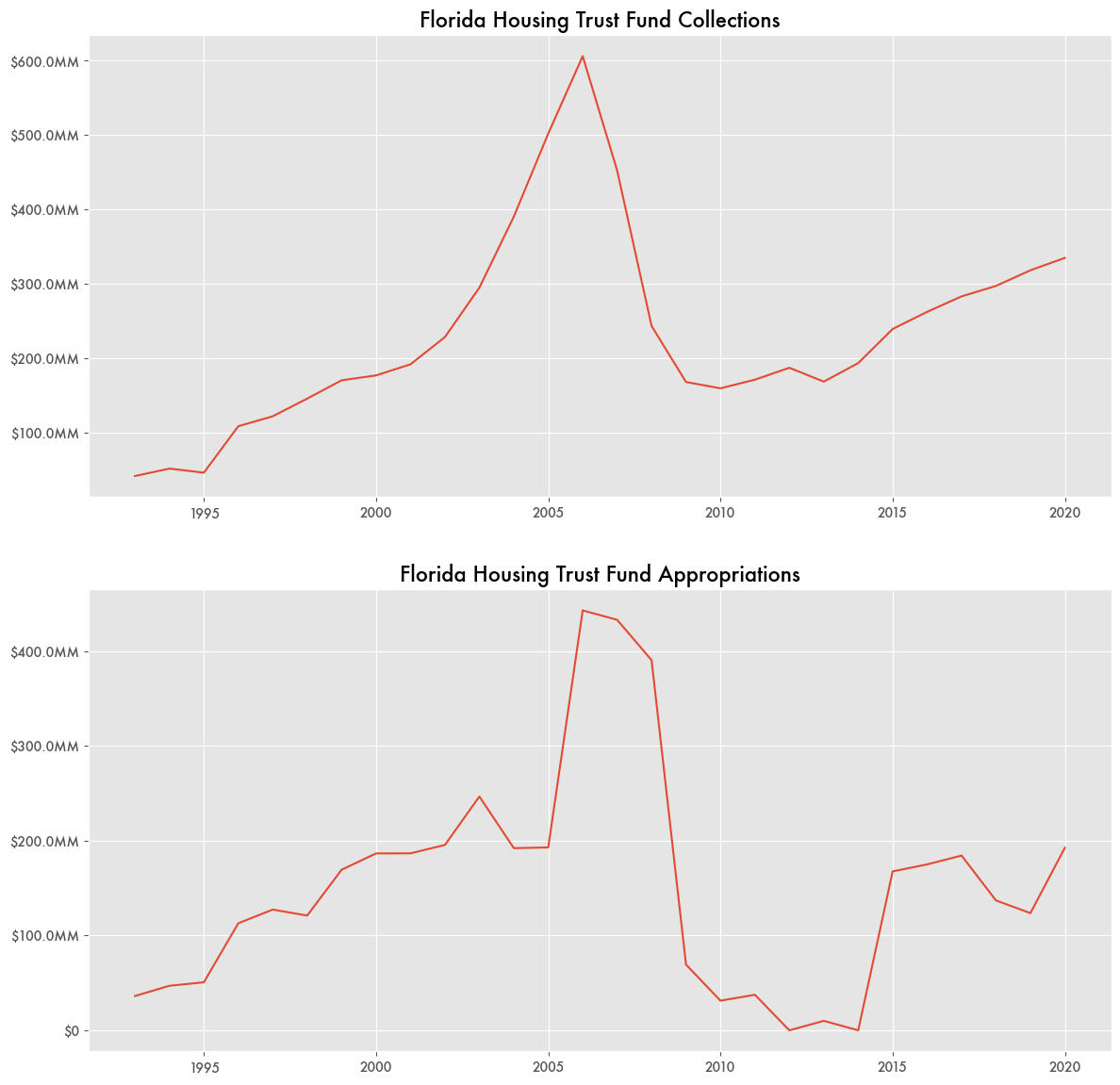
To the second, major funding for housing support disappeared as homelessness declined. They were still collecting hundreds of millions, but they weren’t appropriating any of it to housing.
The state collects hundreds of millions a year for its housing trust fund based on the 1992 Sadowski Housing Act, which funds programs like the State Housing Initiatives Partnership (SHIP) and the State Apartment Incentive Loan (SAIL) through the documentary stamp tax—a tax on real estate document filings.
But starting in 2009 and through 2014, much of that money got swept into the state’s general fund to plug other budgetary holes. In 2012 and 2014, 100 percent of the housing trust fund was used to plug the budget and none of it got spent on housing—right smack dab in the middle of Florida’s supposed rehousing initiative.
Other metrics, like the count of sheltered homeless barely budged during this period as well, showing no indication that the homeless were being moved into temporary housing, like homeless shelters.
Previously, when the housing programs were receiving and appropriating millions—over $600 million in 2006 alone—it had little affect on homelessness as the point-in-time estimates kept climbing into 2010.