
At a time, Lehman Brothers was the fourth largest investment bank in the U.S. before its spectacular collapse during the subprime financial crisis.
Unlike Bear Stearns, nobody came to buy it or save it when the markets collapsed, and it entered into bankruptcy at the nadir of the financial collapse on Monday, September 15th of 2008, largely attributed to its real estate holdings.
“Lehman was unable to maintain confidence because a series of business decisions had left it with heavy concentrations of illiquid assets with deteriorating values such as residential and commercial real estate”
While Lehman certainly had significant real estate holdings, it wasn’t heavily invested in subprime loans, securitized or otherwise. Security and Exchange Commission (SEC) filings show subprime holdings of $5.3 billion in 2007, half of which were sold off by 2008—not insignificant but a sliver compared to the $77 billion in other real estate assets held in 2007, or the $313 billion in total held financial instruments.
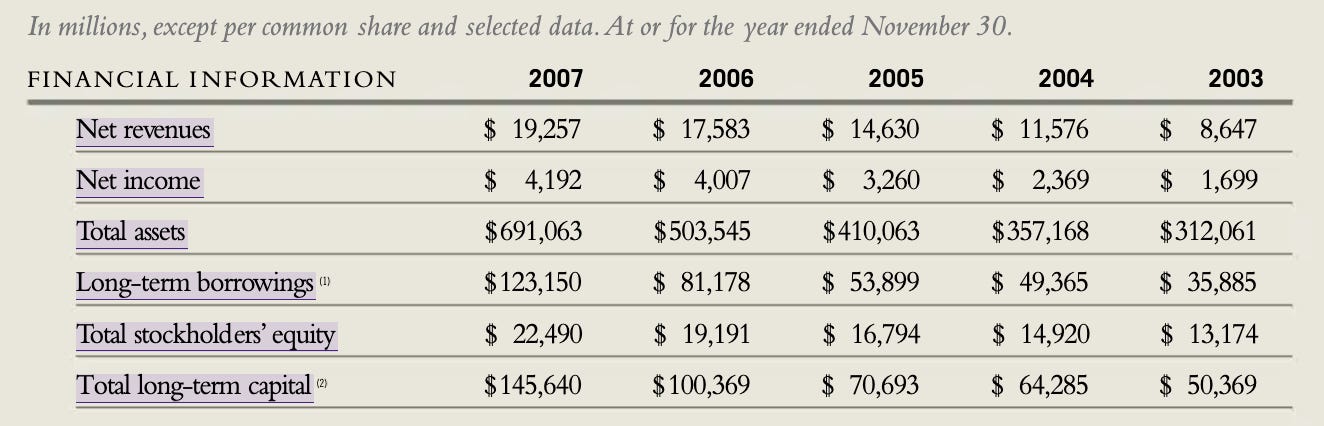
Accusations that it “sunk $221 billion into subprime lenders between 2000 and 2007” may be confusing origination and securitization with actual investment in subprime lending. Net earnings, revenue, and income had all been increasing year over year into 2007.
Lehman’s subsidiaries BNC Mortgage and Aurora Loan Services originated and serviced subprime and Alt-A loans respectively, but they didn’t hold onto that much—similar to what Countrywide was doing.
Aurora was servicing about $97 billion in loans in the first quarter of 2007 and originating $3.3 billion a month. In 2007, BNC originated $5.6 billion.
When the market started collapsing, their loan portfolios suffered slightly, but not egregiously. Internal Lehman documents showed delinquencies for Aurora’s servicing portfolio going from $97 billion of assets on 470,766 in loans to $114 billion on 525,028 of loans.
For BNC, the 60-days delinquency rate increased 1.60 percentage points between the end of 2005 and 2006, and the 12-month delinquency rate went from 3.5 to 6.2 percent over a year—significant trends but not the signs of total financial collapse.
BNC and Aurora weren’t inundated with the predatory borrowing and falsified loan applications that enveloped markets in California and Florida, although there was one major accusation that was settled out of court and a $7.5 million settlement was reached related to being defrauded by a mortgage servicer in 2012.
Outside of BNC and Aurora, Lehman was a large holder of commercial real estate. The largest of which was their subsidiary Archstone Capital ($4.88 billion market value in 2007), but also holdings in Diversity Funding, Prologis Portfolio, and Hilton Hotels ($1.482 billion) among others.
The purchase of Archstone was sometimes described as a millstone around Lehman’s neck because of the risk of purchasing high-end apartments in places like Manhattan, California, and Washington, D.C.
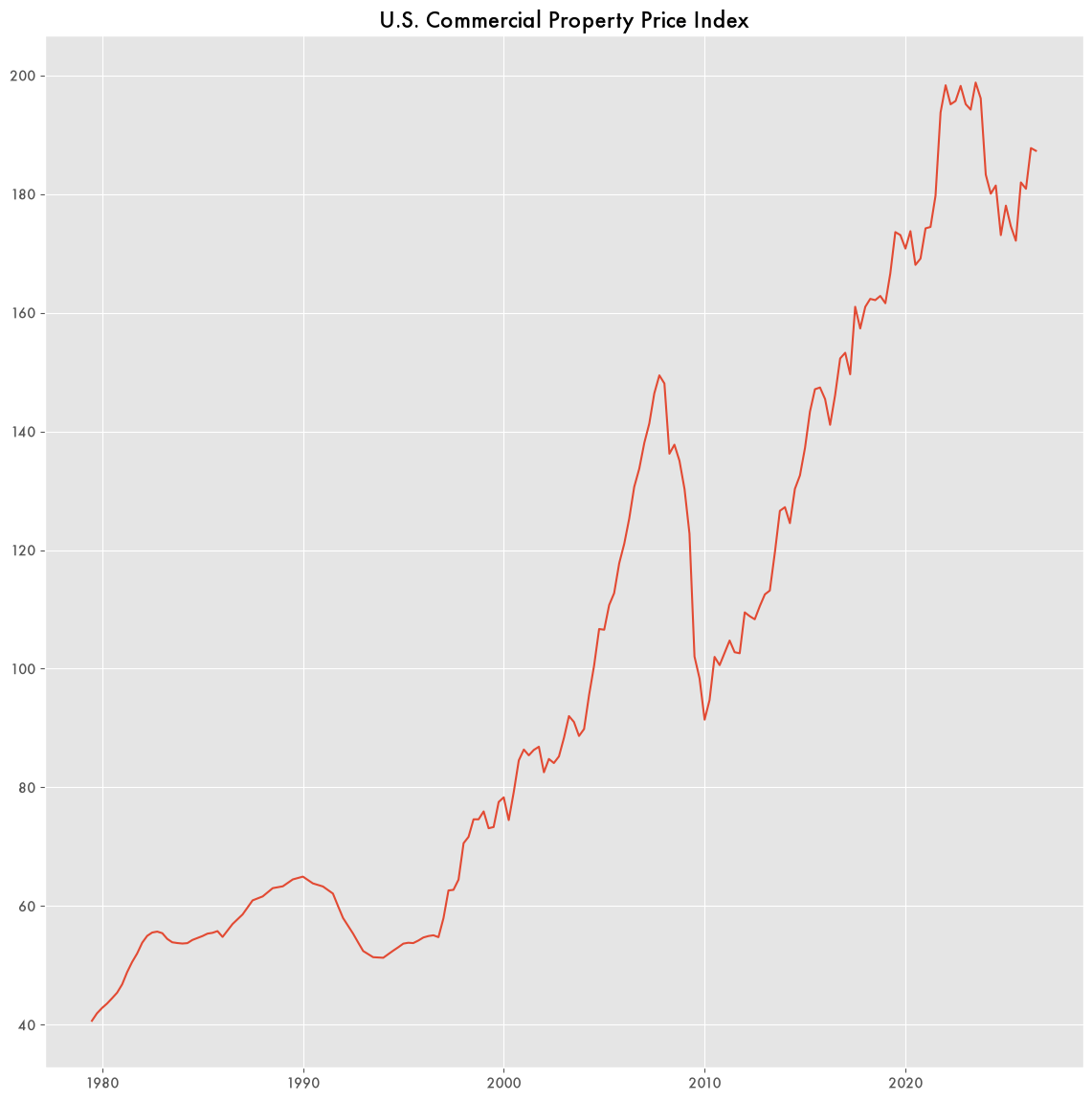
While commercial real estate would see the same flood of delinquencies and price collapse like that of residential real estate, there was never a good reason for it. Commercial real estate was never associated with the subprime crisis or predatory borrowing in any significant way.
Like residential real estate, the collapse in prices was a temporary blip. Nationwide, real estate prices would return to what they were within a few years, both for residential and commercial.
Bank Run On a Non-Bank
But in the meantime, the mark-to-market valuation of Lehman Brother’s holdings evaporated as real estate values fell. Gross write-downs in current value would drop by over $17 billion in 2007. Any company with major real estate holdings would have suffered a similar fate, except that Lehman was also heavily leveraged and had little credit to lean on to survive the credit crunch.
Lehman also infamously used an accounting trick dubbed “Repo 105” wherein the financial institution would sell off assets that they would agree to repurchase in a few days to hide temporarily remove $50 billion of assets from its balance sheet and bury its total leverage, something discovered during bankruptcies proceedings in the Valukas report. When Repo 105 transactions were removed, Lehman’s net leverage—total debt minus cash divided by earnings (EBITDA)—might be 1.7 points higher.
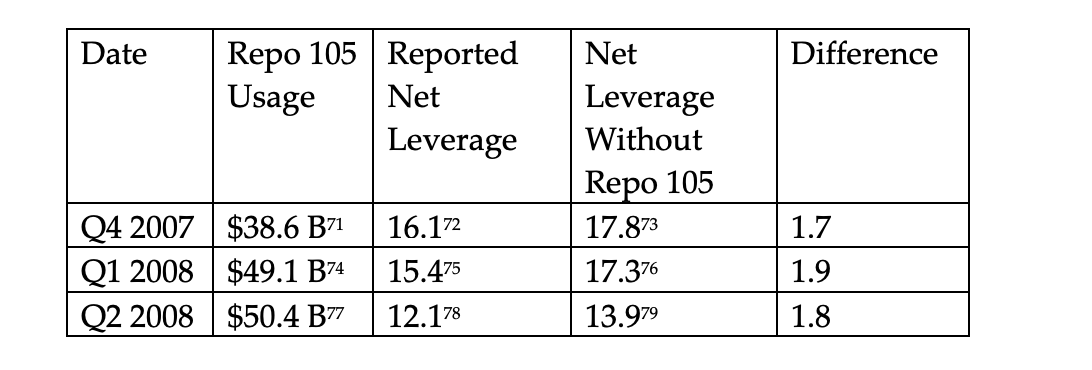
While Repo 105 might have been an accounting gimmick, the difference might not be all that significant. Lehman wasn’t unique in its leverage at the time. Numerous other financial institutions had net leverage ratios over 15x. Merrill Lynch was over 20x in late 2007. After selling off numerous assets, Lehman’s net leverage without Repo 105 was down to 13.9x.
And ratings agencies supported Lehman’s financial health. Moody’s reported that:
“Lehman’s liquidity management and position remain robust and are underpinned by a funding framework that is scaled to the firm’s expectations for, and vetting of, reliable secured funding.”
According to Fitch:
“Liquidity remains strong with Lehman’s lower reliance on short-term funding relative to its peers.”
Lehman would try to shore up concerns about its liquidity buy selling off assets, reassuring investors, using repos with J.P Morgan to get more capital, and various other temporary stopgaps. Yet eventually a run on the financial institution would ensue following the failure of negotiations with the Korean Development Bank to help shore up funding as well as Lehman’s disappointing earning announcement on September 10.
Lehman’s woes piled on top of each other. Its repo funding—loans from other financial institutions for a short as one day and kept them on a short leash—was eventually cut off, J.P Morgan demanded more in collateral, Citigroup said it would stop clearing Lehman’s currency trades, and its ratings were downgraded. Without any collateral, it faced default and potentially criminal action in the U.K. if it continued to operate.
Lehman would then file for bankruptcy, with its assets sold off to other financial institutions like Barclay’s, Nomura, Equity Residential, and AvalonBay Communities. The investment management company Neuberger Berman would be sold to Bain Capital.
Apartment buildings held by Archstone—like Archstone Chelsea, Archstone 101 West End, and Archstone Santa Clara—have only gone up in value since prior to the financial crisis, sometimes doubling in value.
This last month the law firm that handled Lehman Brothers’ bankruptcy, Weil Gotshal, itself would file for bankruptcy.