
Arabella Advisors is a Washington, DC nonprofit consultancy known for its oversight of major liberal philanthropies that recently announced it was acquired by Sunflower Services.
It’s often associated with the influence of other Democratic-aligned nonprofit networks like that of George Soros’s Open Societies, Tides Center, the Rockefeller Brothers Fund, and the Ford Foundation among others.
In particular, Arabella is known for its political influence. It manages large donor-advised funds like the New Venture Fund, Windward Fund, and Hopewell Fund that hand out grants to large scale environmental and civil rights groups in the U.S., but it is also known for standing up nonprofits as political advocacy arms that seem solely intent on affecting elections rather than standard nonprofit activity.
Internal Revenue Service (IRS) rules on nonprofits filing under 501(c)4 designations for advocacy organizations allow for some amount of political activity, often interpreted as a maximum of 50 percent of their expenditures. And effectively no political activity can be allowed for those under the 501(c)3 designation usually used for grantmaking organizations. But there is a lot of detail to those rules that are ripe for abuse. For example, a 501(c)3 organization can do voter registration as long as it’s not specifically partisan.
A 501(c)3 organization also can’t donate to a political candidate. But it can grant money to a 501(c)4 organization in its network who then grants money to a political committee or a 527 political group—like tax exempt political action committees (PACs). The 501(c)3s managed by Arabella make no political donations, but the one major 501(c)4 organization in the Arabella network, the Sixteen Thirty Fund, does exactly that and funds numerous PACs.
Since the original source of those funds are donor-advised funds, which obscure the identity of the original contribution, it effectively means anonymous money in American politics, which is why the Arabella funds are often described as “dark money hubs.”
One of the main donors to Sixteen Thirty Fund is the Swiss billionaire Hansjorg Wyss through his Bergen Fund. As a foreign national, he is prevented from donating to any candidate, although he actively donated directly to candidates for years between 1990 and 2006 and the Federal Election Commission (FEC) simply neglected to prosecute him for it. According to a recent Politico story, Sixteen Thirty spent $330 million on a range of liberal causes in 2024 election campaigns.
Wyss could still be donating to political campaigns, but since the money would have to go through multiple nonprofits that obscure their source, there’s no real way to tell how much of it is his own.
Quasi-Political Nonprofits
Then there are what might be termed quasi-political nonprofits. These are 501(c)4 advocacy groups for nonpartisan issues which can become heavily partisan political arms in how they are operated.
These are groups like Accountable.us, America Votes, the Fwd.us Education Fund, Center for American Progress Action Fund, Iowa Forward, or Maine Momentum that describe themselves as nonpartisan advocacy organizations focused on organizing and voter registration, but are often connected to political campaigns and might even share an office with a PAC.
Some are voting advocacy nonprofits, ostensibly nonpartisan groups aimed at the betterment of society by promoting increased voter turnout for the general electorate. But that nonpartisan activity becomes actively partisan when it is aimed at hypertargeted demographics that are likely to vote for one party over another.
For example, Virginia Organizing is a 501(c)3 that received $783,818 from the New Venture Fund that year, and their website describes the group as nonpartisan organizers focused on workers’ rights, challenging injustice, and equal opportunities for all. Not necessarily Democratically aligned, but highly likely to be, and 100 percent of political contributions from employees of the organization went to Democratic candidates based on Federal Elections Commission (FEC) data.
Similarly, the 501(c)3 Voter Registration Project received $1 million from New Venture and describes itself as a:
“…non-partisan voter registration and mobilization to under-represented ethnic and socio-economic groups in the United States, including African-American, Latino, Native American and low-income voters.”
In theory it is nonpartisan, but the likelihood of it being used as a partisan get-out-the vote campaign is hard to deny.
Nonprofits Giving to Nonprofits Giving to Campaigns
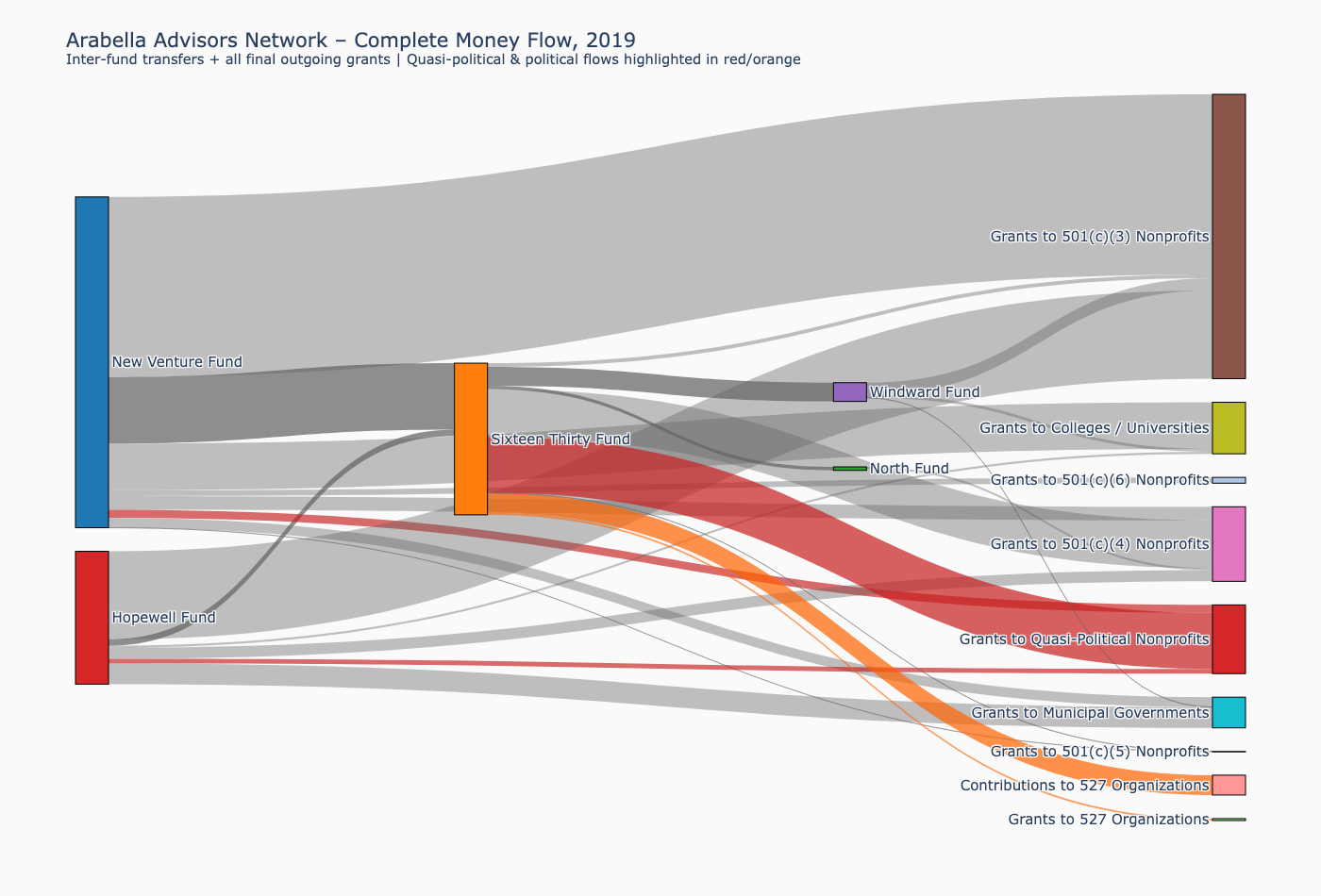
Based on 2019 IRS filings for Arabella’s New Venture Fund and Windward Fund, the majority of their grants ($89 million) go to 501(c)3 organizations unlikely to have any direct political activity. These are well established liberal civil rights and environmental nonprofits like the ACLU or Nature Conservancy. Another $23 million went to colleges and universities. Others are semi-governmental organizations—nonprofits created by governments but that also involve private funds—like the California Commission on Status of Women and Girls ($10.3 million) or the World Bank ($3.9 million).
But a full $33 million in grants from New Venture went to the Sixteen Thirty Fund in 2019, which is registered as a 501(c)4 and is much more politically active with its funding. Of the almost $65 million in grantmaking for Sixteen Thirty that year, $9.9 million were explicit contributions to PACs and $27.8 million went to quasi-political nonprofits. Another $965,000 were grants—rather than contributions—to PACs.
Thousands of Small Grants
While large grants to research institutions like state universities or medical research like the Jonas Salk Institute for Biological Studies might be considered common philanthropic ends, the vast majority of Arabella recipients are small dollar donations, likely only to cover a few employees for a year.
Eighty percent of grants were for less than $250,000. About 50 percent were less than $100,000. Despite sitting on assets of over $500 million in 2019—and likely over $1 billion in 2024—the fund only drips out small grants to small nonprofits. A $75,000 grant to the West Virginia Citizen Action Education Fund was half of the organization’s total revenue for the year.
But there are a lot of them. In total, there were 996 unique nonprofits benefitting from Arabella’s funds, many under the category of “Civil Rights, Social Action, Advocacy”, but also environment, health, and capacity building—a somewhat vague term that implies funding for some activity in the future. Some are activist groups commonly found doing street protests, like the People’s Institute ($50k), or those for women’s reproductive health through the Kentucky Health Justice Network ($7,000).