Every year cities participate in the Department of Housing and Urban Development (HUD)’s Point in Time (PIT) estimate of the homeless population.
It’s likely the most accurate survey of how many are considered homeless at one time—either living on the street (unsheltered) or in some kind of temporary housing (sheltered).
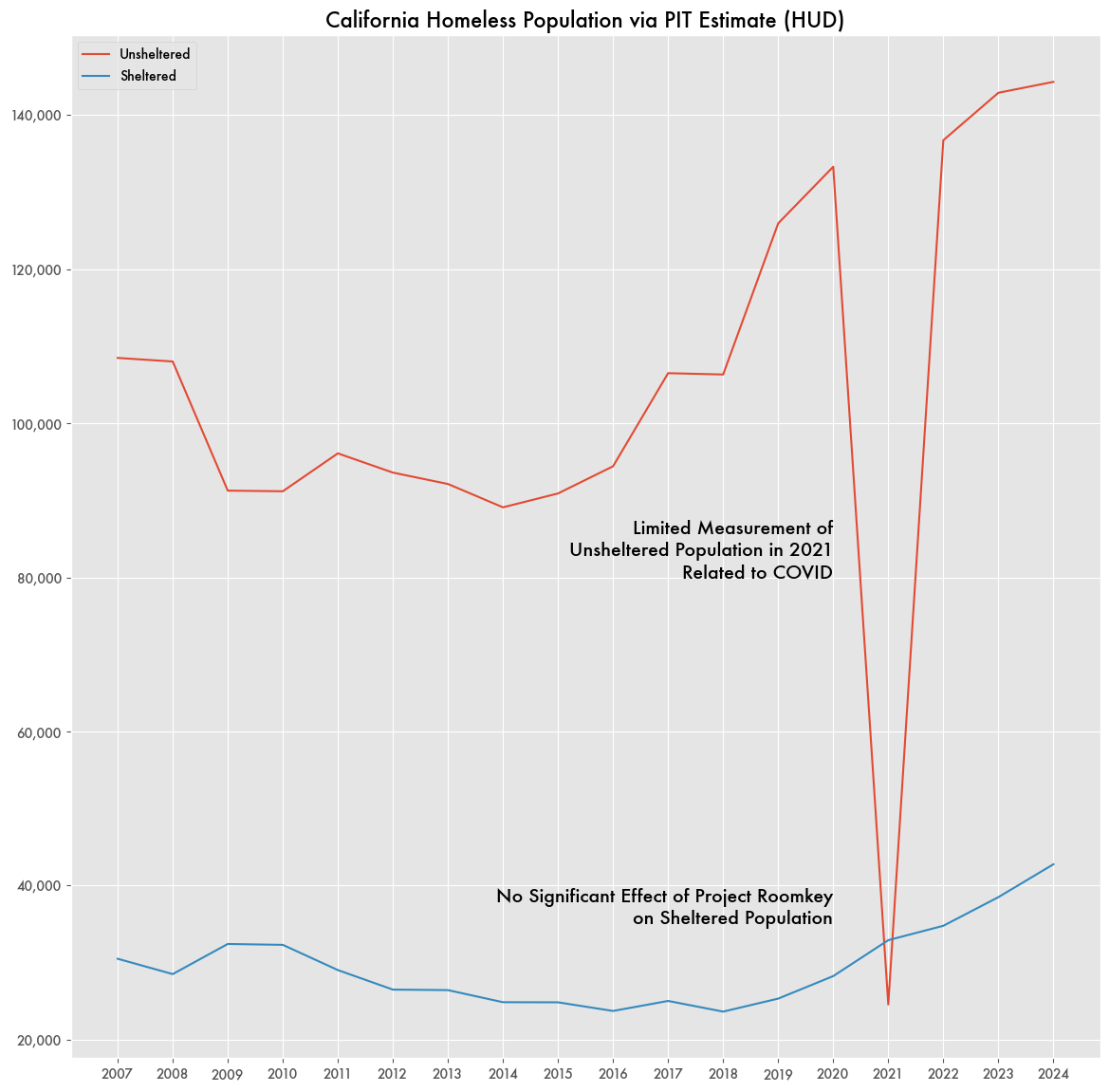
When the pandemic hit in 2020, COVID restrictions hampered the survey out of concern for public health. As a result, data on total unsheltered homeless population in 2021 would show an enormous drop, almost 200,000, from a lack of reporting.
Fifty percent of that drop was because of a lack of reporting in California alone. Not just because California as a state is large, but it also has an outsized homeless population—27 percent of national total in 2020—and it limited its homeless survey the most in 2021. Plenty of other states—Alaska, Delaware, Virginia, and Rhode Island among others—surveyed their homeless population in 2021 with no issue related to COVID and saw little to no change in their numbers.
According to a report from California, homelessness likely declined during the pandemic in California as the state actively arranged to house individuals through Project Roomkey—a temporary measure to give housing to anybody who tested positive for COVID or similar health concerns, or over the age of 65.
Supposedly 62,000 individuals were given temporary housing as part of the program, with a peak of 16,000 committed hotel/motel rooms in use. Over 12,422 were housed in Los Angeles County alone, which is actually relatively low considering that Los Angeles has the highest homeless population in the U.S. and represented around 40 percent of California’s homeless (69,144) at the time—although the Project Roomkey estimate puts it at a higher 91,145 total homeless (65 percent)—yet L.A. represented only 20 percent of Project Roomkey participants.
The state saw no real change in the sheltered population—the kind that would fall under the housing provided by Project Roomkey and wasn’t affected by COVID limitations. There were less than 33,000 sheltered homeless in the state at the time anyhow so growth by 62,000 would certainly show in the numbers somehow.
The project ended in summer of 2022 and all temporarily housed individuals since left where they were staying. The HUD PIT survey is all done in January, so even if a few thousand housed individuals were still there, that would likely show up in the 2022 estimates for unsheltered, but no such decline is apparent.