
The current labor market is described as historically tight; there are many more job openings than there are unemployed workers looking for jobs. Supposedly, companies are desperate for workers to fill the litany of roles they have open.
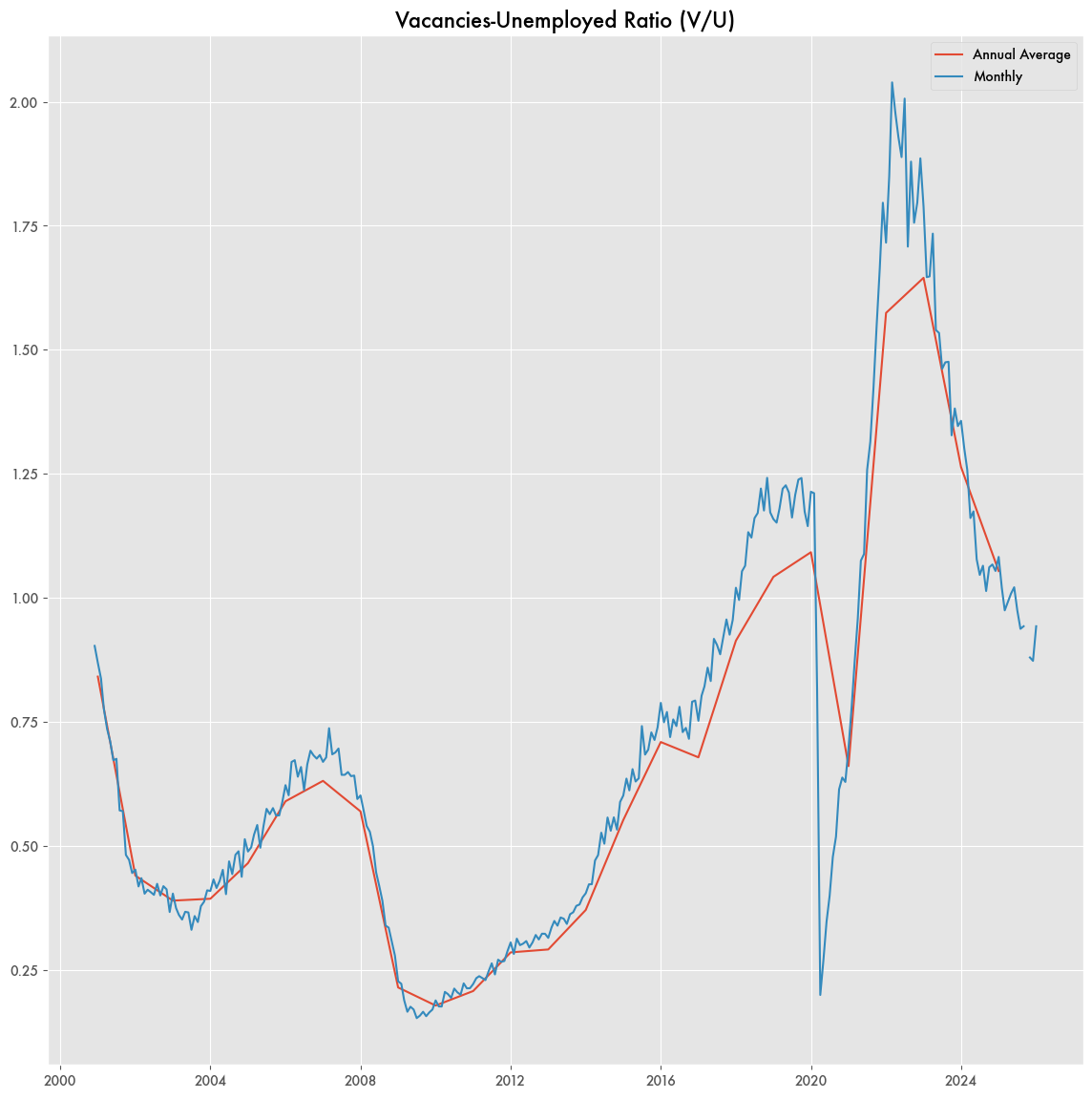
If that doesn’t seem right, you’re not alone. The Richmond Federal Reserve noted how that doesn’t seem to comport with reality in a November 2025 post showing a considerably high vacancies-to-unemployed ratio (V/U rate) of .98. And only a few years prior it was twice that.
Is something fishy going on with job openings? With 7.2 million job openings as of August 2025, vacancies seem high, especially relative to the five-year pre-pandemic average of 6.4 million. Vacancies also seem high relative to unemployed workers.
Another post from the Saint Louis Federal Reserve asked a similar question. If the labor market is so tight, why aren’t wages higher? If workers are in such high demand, then they could demand more money.
All of this is relatively new. Prior to the financial collapse, the V/U rate barely ever got above .7. But beginning in 2010, post-financial collapse, the economy has been continually creating millions of jobs that are not getting filled.
Not only are they not getting filled, they might be sitting around unfilled for years. Even as the economy adds jobs that get filled, the number of job openings rarely goes down even as more and more employees are hired.
Ghost Jobs Aplenty
But there’s good reason for skepticism as many of the openings are likely ghost jobs—fake postings intended for some other purpose besides actually filling a role. Sometimes it’s meant to collect resumes for a job that doesn’t exist just yet. Sometimes it’s done to create a façade of growth for a flailing company.
Various estimates have put the number of ghost jobs between 20 to 40 percent of all jobs or at least 2 million, which is the minimum number of job openings in Bureau of Labor Statistics (BLS) data that never seem to go away. Besides misleading applicants, ghost job openings skew the labor market, making it appear that the economy is more robust and flush with jobs than it is, that wages should be higher, and that there isn’t enough skilled labor to fill the gap.
But there’s good reason to believe that the number of ghost job openings could be much higher, or at least that the Job Openings and Labor Turnover Survey (JOLTS) that the number is based on, is significantly flawed.
That’s because the number of added job openings is unrealistically high. Since 2010, the economy has almost continually added more employment—an average of 2 million jobs added each year—yet the number of job openings keeps going up. What was 2.8 million job openings in 2009 is now regularly over 8 million.
Assuming that every added job—e.g. net hires, or total hires minus total separations—had a job opening, that means that for every job filled there is a new job opening to replace it plus a few more to account for the increasing number of openings.
That works out to a seemingly impossible 193 million net job openings added since 2000—an average of 7.7 million net job openings added per year. Considering that there are currently 156 million jobs in the economy, it would mean more than one job opening added for every job in the economy.
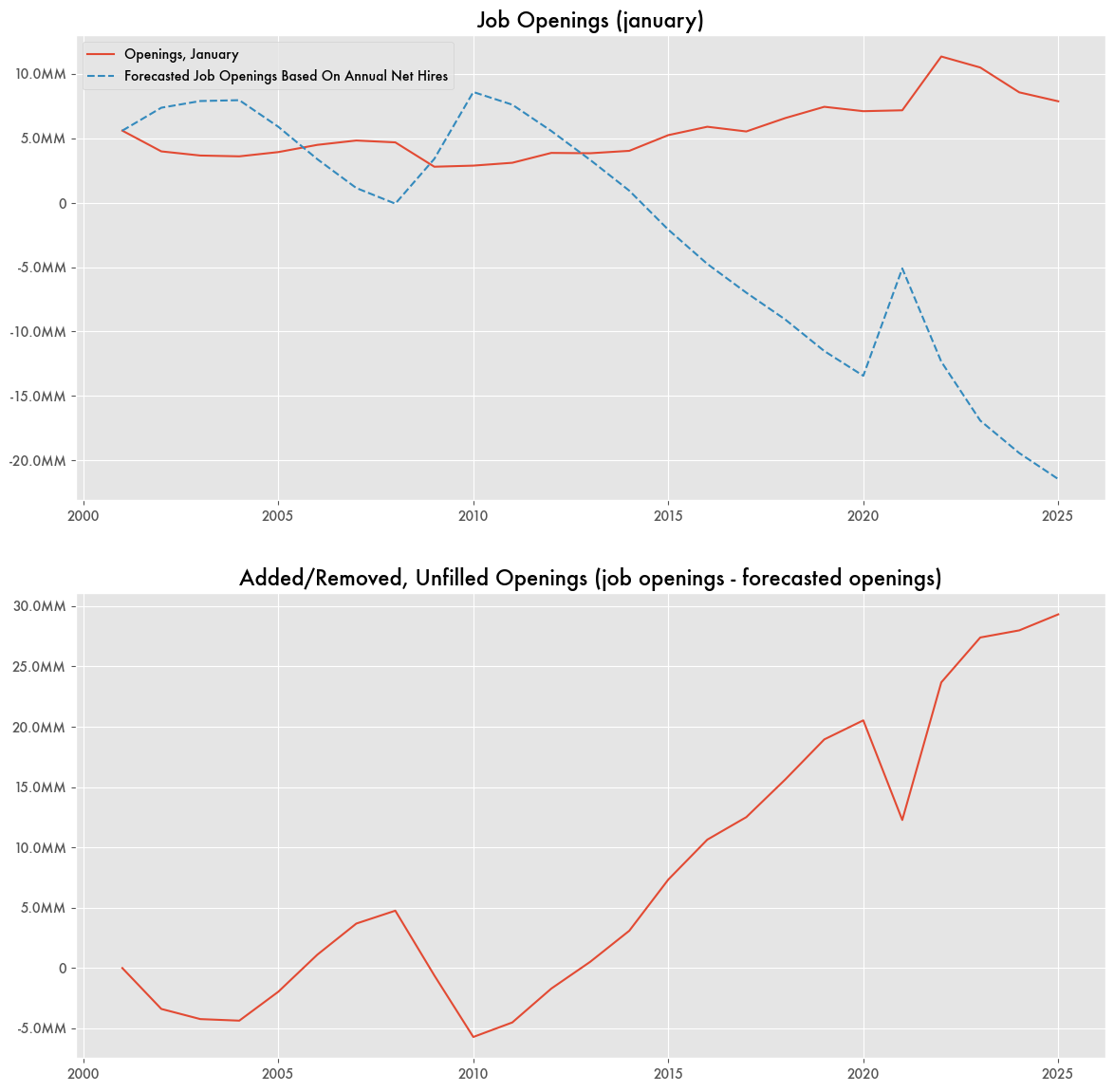
Job Openings = J₀ (Openings in 2001) - Net Hires ( Hires - Separations ) + Added/Removed Job Openings
Added/Removed Job Openings = Job Openings - (J₀ - Net Hires ( Hires - Separations ))
More Reasonable Pre-Crisis
Job opening numbers were not as specious prior to 2010. Before then, the potential number of added or removed job openings varied between plus or minus 5 million a year. That’s because the number of job openings actually declined at various points when people got hired.
If the current number of job openings was similar to what it was back then—around 5 million rather than 10 million—then the V/U rate would also be similar to what it was —about .5. Not a considerably tight labor market.