The most common source of carbon dioxide measurements in the atmosphere is the National Oceanic and Atmospheric Administration’s (NOAA) Mauna Loa observatory on the top of the Mauna Loa volcano in Hawaii. It’s been continuously measuring atmospheric conditions since the 1950s free from direct air pollutants and human interference at a high elevation.
Originally established by Charles Keeling—the climate scientist given credit for confirming human-based global warming—while working at the Scripps Institution for Oceanography at the University of California, which was heavily funded by the major oil companies of the day.
It’s also regularly the data source that atmospheric carbon dioxide is growing unsustainably, leading to excessive global warming. Numbers from Mauna Loa have shown carbon dioxide levels consistently growing year over year without end, implying that natural sources of carbon dioxide absorption—carbon sinks like oceans and forests—are not sufficient to buffer human-based carbon emissions and therefore catastrophe is inevitable.
But Mauna Loa’s consistent growth is almost too consistent. If Mauna Loa is ostensibly a measurement of CO₂ in the atmosphere largely from human emissions, there should be significant varying fluctuations from industrial output, car emissions, and population growth.
Estimates of anthropogenic CO₂ emissions—i.e. human-sourced emissions—tend to increase year over year as the global human population grows linearly and there is more industrial consumption, but there are still periods of little growth, particularly around the COVID-19 pandemic or during severe recessions that limit industrial output that would ostensibly show up in CO₂ measurements.
In particular, little change in measurement happened in 2022 when the observatory was shut down due to the eruption of the Mauna Loa volcano. Volcanoes are one of the largest sources of CO₂ emissions, so a volcano erupting right next to the CO₂ observatory would likely show up in the data.
That consistency also applies to other Mauna Loa measurements related to climate change like methane and nitrous oxide. NOAA has a note on its site explaining why COVID-19 might not have an affect on measured CO₂ levels as there is no photochemical destruction of atmospheric CO₂ as there is for other gases.
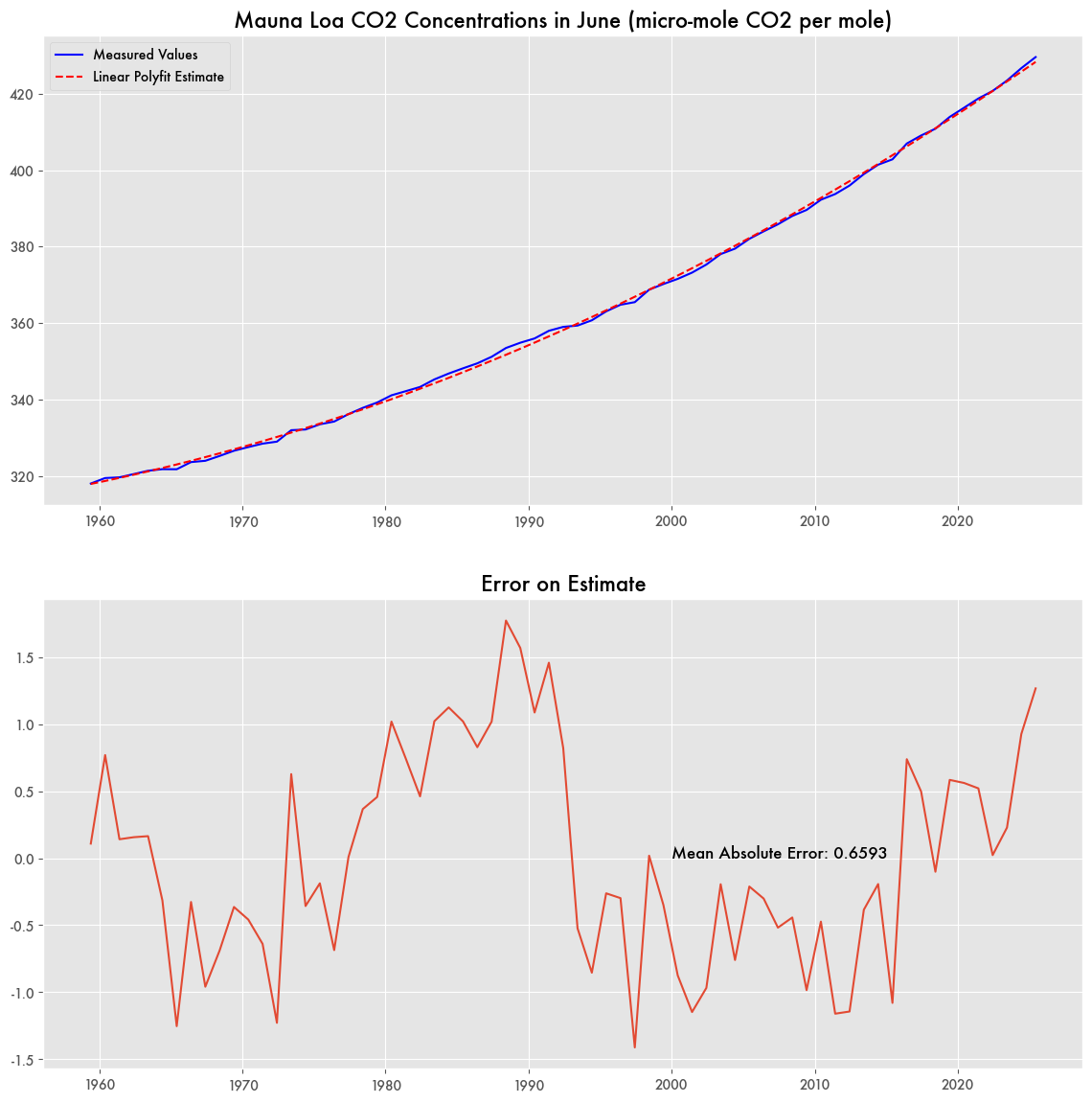
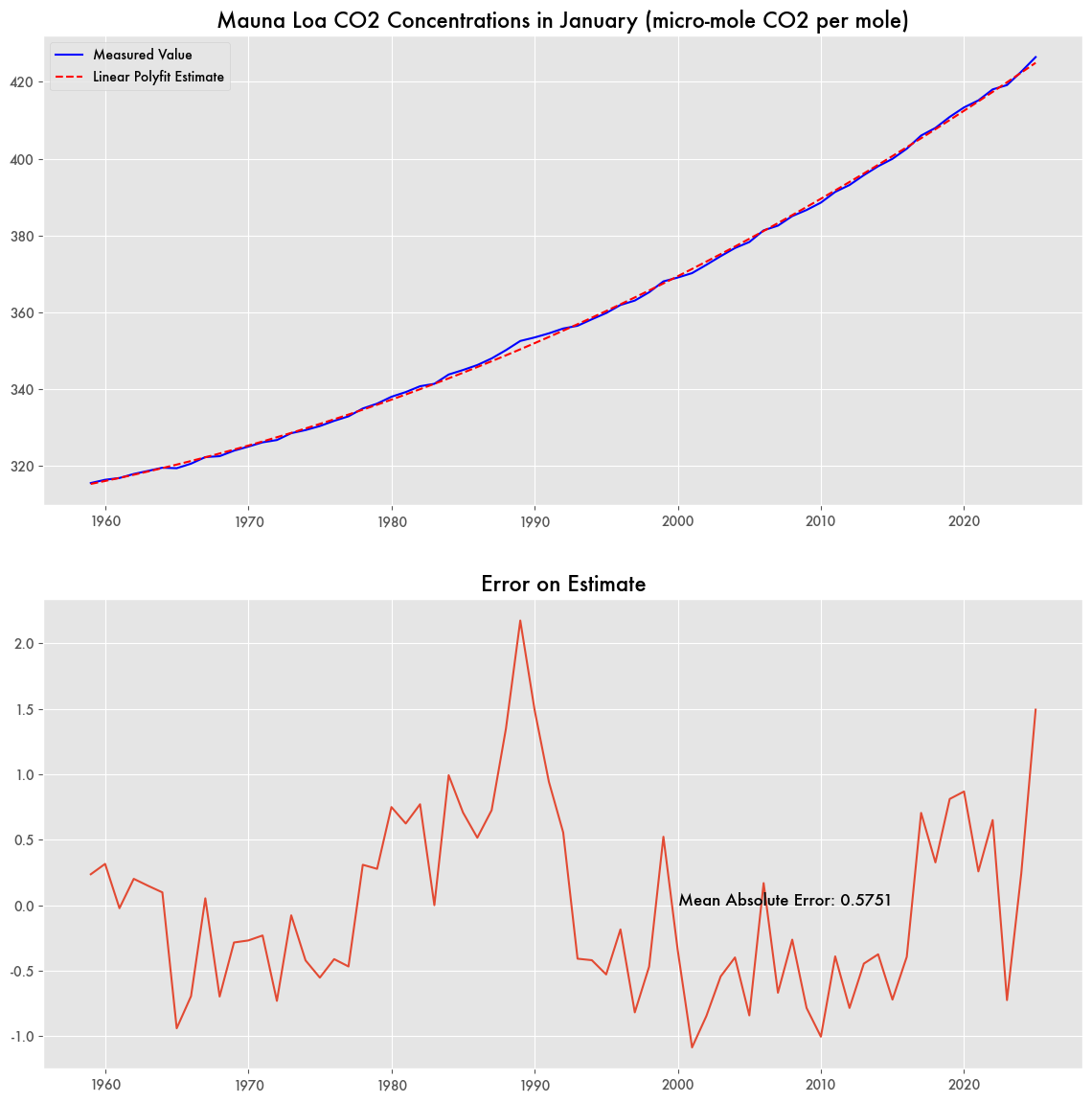
But no matter what, Mauna Loa shows such a predictable measurement that a two-dimensional polynomial can accurately represent values within two-tenths of a percent. It increases year over year whether or not volcanoes erupt in front of it, oil consumption collapses, or industrial output comes to a halt.
For measurements in January, the following equation will predict the Mauna Loa CO₂ value given the number of years since 1959:
The measurements vary from month to month, but a similar two dimensional polynomial equation works for any month. This is the one for June: