
In his second term as president, Trump has taken a focus on the Kennedy Center for the Performing Arts in Washington, DC among other local D.C. projects. A majority of the building was shut down beginning in 2025 for two years of repairs costing $257 million that were approved by Congress under the Big Beautiful Bill, and Trump pushed to have his name added to the façade, which has since been removed.
As a result of construction, performances have been halted with the National Symphony Orchestra temporary playing at other venues in the D.C. area.
In September, protests along with ongoing litigation sprung up to stop the construction similar to those against construction of the East wing of the White House. Thousands formed a human chain around the building dubbed “Hands Around the Kennedy Center.”
Numerous accusations have been levied that the Trump administration intentionally let the building fall into disrepair and that they are using the opportunity to hide financial mismanagement and declining ticket sales as a result of the Trump takeover. Supposedly, despite the large amount of money dedicated to the renovation, repairs have been done quickly and shoddily.
In response, Trump described the repairs as necessary as the state of the building is in severe disrepair and potentially deadly to visitors. A tour of the facility in April of 2026 showed decaying concrete, old boilers, and other wear and tear.
But really the Center’s finances were in the red prior to Trump’s election, following the pandemic. Ticket sales, which falls under the category of program service revenue, had been at historic highs in 2019 then collapsed for two years as the economy came to a halt in 2020. Philanthropic contributions, which tend to follow ticket sales, also fell. Net revenues, which topped $71 million in 2019, quickly went negative. The CARES Act appropriated $20 million in funds for the Center to help patch some financial holes, while lots of employees were laid off or furloughed.
The federal government provides grants of around $50 million a year for line items like operations and management and capital restoration for around 50 full-time equivalent employees, but there can be thousands of employees that work part-time at the Center based on what events are scheduled.
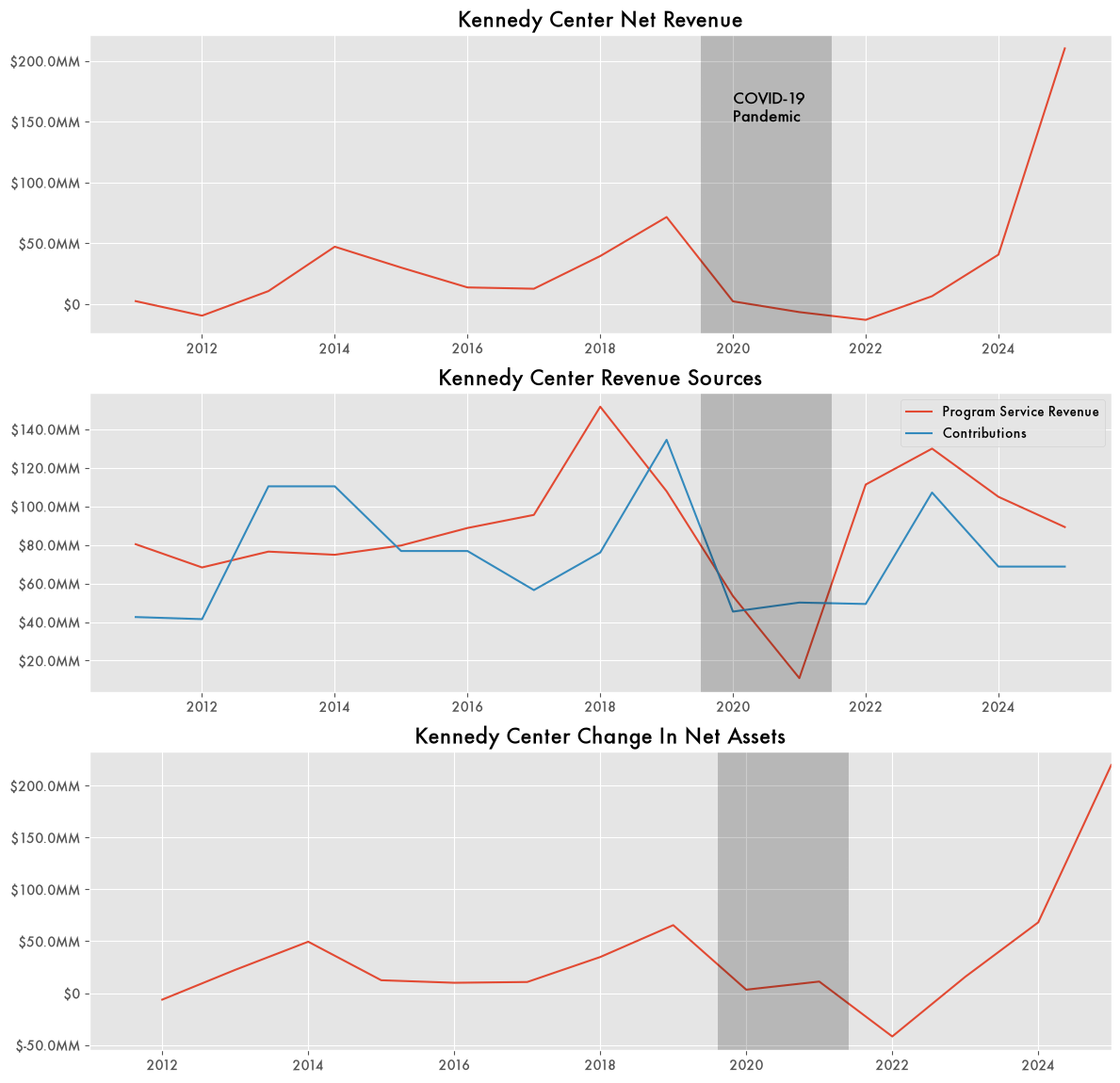
By 2024, annual numbers were back to about what they were 10 years prior, but two years had gone by with few shows, little in the way of savings built up for future shows, and the building was showing signs of major wear that weren’t fixed during the pandemic, including:
A 2021 report from the Government Accountability Office listed a need to resurface the garages, renovate the terrace theater, and modernize utilities.
A 2021 and 2022 Comprehensive Building Plan included numerous completed projects like the optimizing the hydronic system, HVAC cleaning, and various parking garage fixes, but there was plenty still to be done like fixing roof leaks and HVAC upgrades.