
While much attention has been paid to predatory lending leading up to the subprime crisis—high-interest lending without the borrowers knowing the ramifications—numerous states were more awash in predatory borrowing—where borrowers falsify details to obtain loans they wouldn’t otherwise qualify for.
Alt-A, or Alternative A-paper, loans in particular were often described as “liar loans” where the borrowers misled the lenders about how much they earned and were almost as prolific as subprime loans.
Sometimes they are also alt-doc, or alternative documentation, loans, where the borrower provides alternate proof of their ability to pay back the loan. For example, a number of home equity lines of credit (HELOC) loans might be considered alt-doc loans as the borrower doesn’t use proof of income but just proof of home ownership to borrow against.
Alt-A are often jumbo loans with large loan-to-value (LTV) ratios, say for someone borrowing enough to for their current mortgage and a second house at the same time. A loan using their current home equity as collateral could be both Atl-A and Alt-doc.
Alt-A and Alt-doc lending is reasonable except that much of the lending surrounding them and subprime loans was fraudulent during the subprime crisis, not because they used alternative information as collateral but because the applicant lied about everything in their paperwork.
According to a 2008 report from the New York Federal Reserve, real-estate fraud investigations doubled between 2001 and 2003, and suspicious activity reports (SARs) filed by federally-regulated institutions related to mortgage fraud increased from 3,500 in 2000 to 28,000 in 2006.
The Mortgage Asset Research Institute (2007) estimates that direct losses from mortgage fraud exceeded $1 billion in 2006, more than double the amount from 2005.
For example, subprime and Alt-A loans originated in 2006 have experienced historical levels of serious early payment default (EPD), defined as being 90 days delinquent only three months after origination.
It wasn’t simply falsifying income on a loan application but a wide range of misrepresentation, coordination, and various other scams and ruses being perpetrated.
False appraisals, fake down payments, ghost borrowers and air loans where the lender invents borrowers out of nothing, or buying a home and renting it with no intention of making mortgage payments. Brokers took out loans in potential investors’ names without the investors knowing that they signed up for a loan. Borrowers would work with lenders to obscure the lack of a down payment and hide how little capital the borrower had on hand.
So much of the lending in the private markets was based solely on the borrower’s self-reporting; not just income, but other determiners of creditworthiness like owner-occupancy and borrower debt.
Owner-occupied properties in particular might be very drastically misrepresented. According to a 2009 paper in the Journal of Economic Perspectives, investor-owned or non-owner-occupied properties only accounted for about 8 percent of subprime loans.
But based on the top three centers of the subprime crisis, it could be much higher than that. The number of vacant properties added each year in Lee, Clark, and Riverside counties was regularly more than the owner-occupied additions, making it seem like the rate of investor-owned properties added was more on the order of 50 percent than 8 percent.
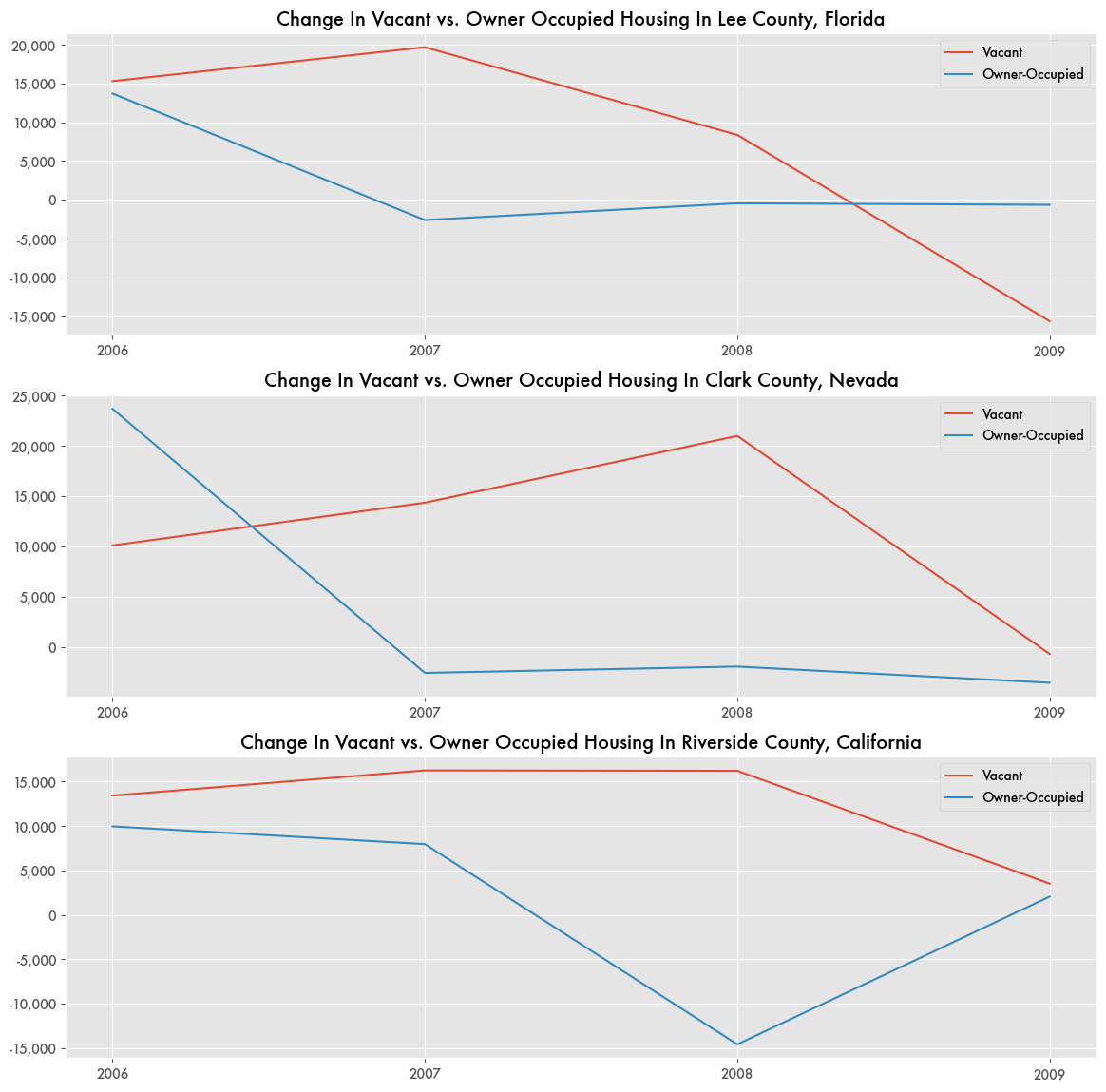
Misrepresentation of owner-occupancy is not a new concept as a 2013 paper from NBER noted that 6 percent of mortgage loans for owner-occupied properties were actually investment properties. Other investors lied about having secondary liens in their name.
More than 6% of mortgage loans reported for owner-occupied properties were given to borrowers with a different primary residence, while more than 7% of loans (13.6% of loans using a broader definition) stating that a junior lien is not present actually had such a second lien. Alternatively put, more than 27% of loans obtained by non-owner occupants misreported their true purpose and more than 15% of loans with closed-end second liens incorrectly reported no presence of such liens.
While documentaries on the financial collapse often talk about the mortgage-backed securities that collect loans into piles which get investment grades and then sell off tranches which are then used for CDOs and swaps. Supposedly, all the risk was buried and intentionally misrepresented because so much money was being made. Ratings agencies were simply rubber-stamping positive AAA ratings because they didn’t want to lose business to other ratings agencies.
That seems hard to believe as significantly falsifying the grade of an investment on a large-scale would be massive fraud on the part of the ratings agencies; not just altering a few loans but thousands of loans. The ratings agencies would make settlements in the millions in related cases, but no real evidence appeared that they manipulated their numbers.
The model that Moody’s used for valuing their subprime loans included all kinds of potential flags that might highlight a risky loan in a tenuous housing market, like debt-to-income ratio, local housing market projections, adjustable interest rate, interest only and negatively amortizing loans, owner occupancy, mortgage insurance, coupon/interest rate, documentation status, and lien type.
But all those metrics would be meaningless if the underlying data was inaccurate. For subprime lending, a lot of it was self-reported. Compare that to Federal Housing Administration (FHA) mortgages that get underwritten by Fannie Mae and Freddie Mac—e.g. not subprime—where income is verified by IRS filings and other government documentation.
Private loan insurers underwrote many of the subprime loans, but they likely did so based on the documentation submitted. Loan originators like Countrywide were blamed for being the first point of entry for subprime loans, who then sold off the loans into the larger market. But Countrywide would have been dependent on the mortgage brokers to validate documents and information in preparation for a loan.
A 2011 Miami Herald story detailed how thousands of felons were signing up to be loan originators in the state because of lax rules for the profession. Another Herald story from 2008 details how the state’s Office of Financial Regulation looked the other way for mortgage brokers’ licensing requirements, skipping background checks, and ignoring signs of crooked mortgage operations. There were repeated attempts to have loan originators licensed, but the industry pushed back.
In 2008, Florida Governor Charlie Crist would block felons from becoming mortgage brokers and push the chief of the state’s Office of Financial Regulation to resign.
California and Nevada weren’t as bad, but they had similar issues. There were no license requirements on brokers in California, and Nevada was rife with mortgage scams and straw buyers.
In the Las Vegas Mazzarella-Grimm case, a couple used a network of LLCs to buy up $107 million worth of houses using straw buyers and sell them to each other to push up home prices.
Since the foreclosure crisis, numerous statues have been put in place to prevent predatory borrowing like this, like the 2008 Secure and Fair Enforcement for Mortgage Licensing Act (SAFE Act) requiring licensing of mortgage brokers and originators, background checks, and validation of owner-occupancy. Dodd-Frank required lenders document a borrower’s ability to pay through the ATR/QM Rule.
Florida would enable fast-tracking of foreclosures, particularly vacant ones by throwing money at the court system, while California and Nevada already had non-judicial foreclosure rules in place.