
What was known as Climategate was a 2009 controversy surrounding hacked emails on a server at the University of East Anglia. Messages between prominent climate researchers like Michael Mann, Keith Briffa, and Phil Jones were leaked to the public, and critics then zeroed in on passages that ostensibly showed the researchers manipulating data to get the outcome they wanted.
Phrases like “Mike’s Nature trick” were references to ongoing issues in years after 1961 where tree ring data no longer correlated with atmospheric temperature data—otherwise known as the “divergence.”
“I’ve just completed Mike’s Nature trick of adding in the real temps to each series for the last 20 years (ie from 1981 onwards) and from 1961 for Keith’s to hide the decline.”
Critics pounced on the language which seemed to implicate some kind of coordinated fraud or unethical massaging of the data.
But scrutiny of the research following Climategate, including an investigation by the National Science Foundation (NSF), would eventually absolve the researchers of any accusations of manipulation.
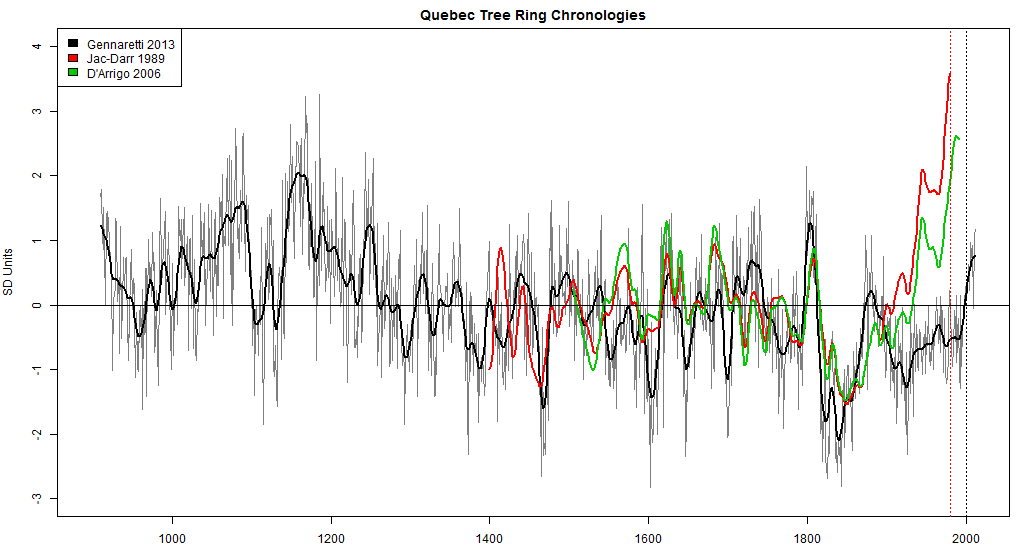
And the divergence issue that was ostensibly being manipulated was largely irrelevant. While divergence is a well-established issue for some tree ring data, not all tree ring data sets have the problem, and it is assumed to be a relic of local conditions for specific tree populations, like droughts and other various theories.
North Cairngorms’ Tree Ring Example
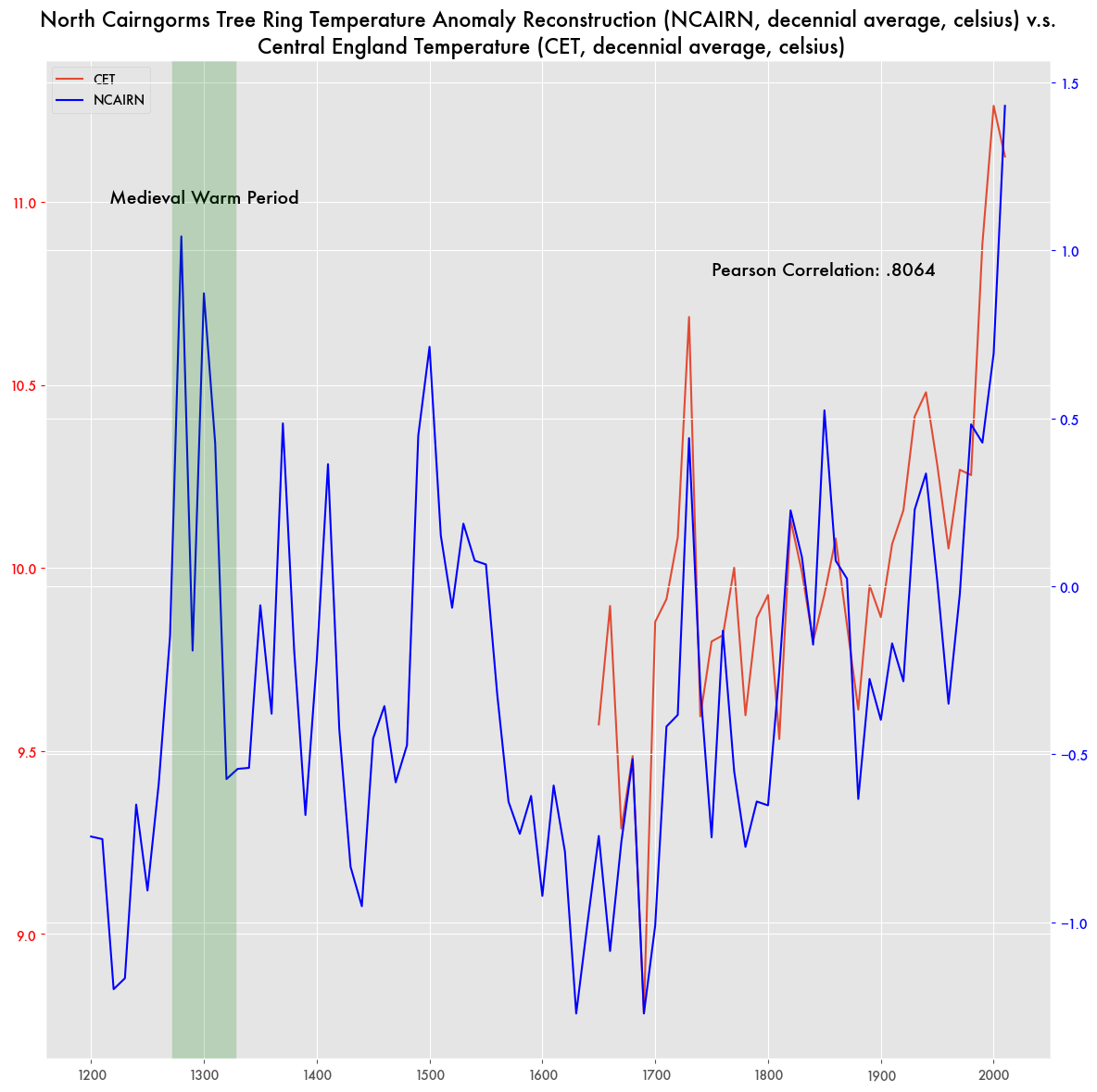
For other tree ring data sets, like the one from North Cairngorms, Scotland (NCAIRN), tree ring data tracks quite well with historic temperature measurements like that of the Central England Temperature (CET) set, which goes back to 1659 AD. Divergence is not an issue there.
The decennial average of atmospheric temperature from CET correlates significantly with the decennial average of temperature anomalies based on the Scottish tree ring widths (Pearson: .8064).
That aligns with the research from climatologist Keith Briffa—who was on the Climategate email exchange—showing the sensitivity of tree growth to temperature. His data showed even higher correlations of over .90 at times depending on the tree ring dataset.
But what was left unsaid is that, if tree ring data is a valid estimate of temperature, then the current day warm period is not that different from prior warm periods, like the Medieval Warm Period around 1300 AD—only off by less than one degree celsius.
It would also be similar to the other warm period in the late 1500s that doesn’t have a unique name.
Tree Ring Data Vs. Mann’s Hockey Stick Graph
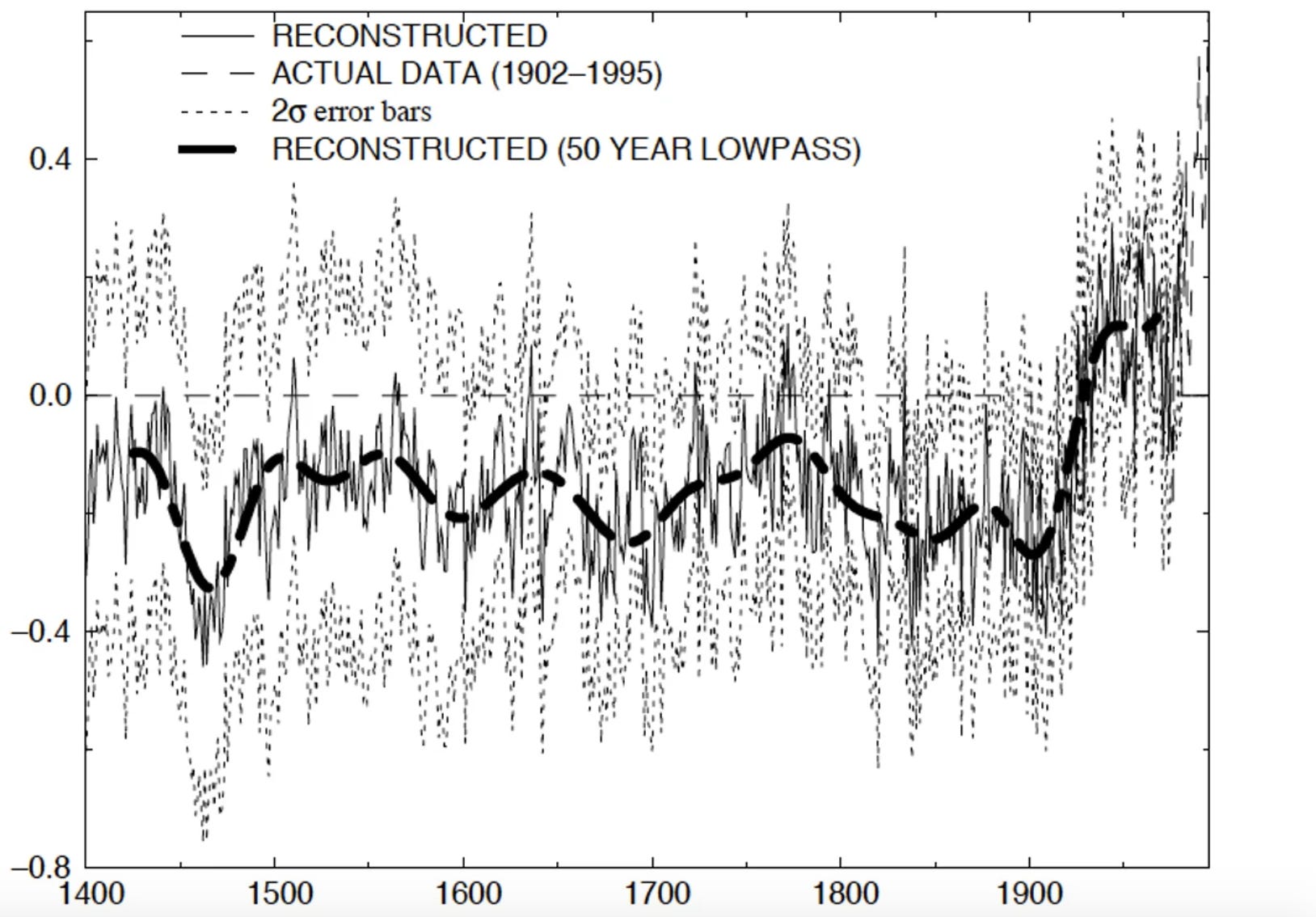
What might be more controversial is that while tree ring data tracks well with historic temperatures, Michael Mann used his own model that incorporated not just tree ring data, but ice core data, corals, lake sediments, historical documents, and other records to develop his “hockey stick” chart showing a much more significant and anomalous uptick in recent temperature compared to prior centuries. In that model, prior warm periods, like the one in the 1500s, don’t appear at all.
While tree ring data is relatively well established as a reliable source of temperature data, minus divergences, ice core data has its own issues when used on more recent time frames.
Cuccinelli vs. Mann’s Source Code
As impactful as Mann’s research is on climate research at-large, his methods for incorporating numerous temperature sources are unknown.
In 2010, then-Virginia attorney general Ken Cuccinelli demanded a wide range of documents from Mann because of the implication of fraud from the Climategate emails.
Cuccinelli used a Virginia anti-fraud statute to demand all communication used by Mann to apply for taxpayer funded grants at the University of Virginia as well as all source code and algorithms used to generate the research.
Eventually the Virginia Supreme Court ruled against Cuccinelli that the state had no right to Mann’s files and the algorithm was never disclosed.