
A prior Investigative Economics article detailed how moving the mentally ill out of large psychiatric institutions into outpatient care or smaller community health facilities—otherwise known as deinstitutionalization—is commonly associated with the rise in the prison population in the 1970s and 1980s, but the two trends can’t be confidently connected.
There is little data on the population of mentally ill in prison, and the data that is there is inconsistent in its definition of mental illness. The larger majority of psychiatric institutions were elderly and many were women—two populations not commonly associated with crime and prison. Local jails could certainly have shouldered the burden of the untreated mentally ill, but there was little systematic evidence to measure and confirm it.
Instead, much more data points to deinstitutionalization affecting the sharp growth in homelessness that began in the 1980s. While data there is also spotty—there were few surveys of the homeless population back then and even fewer of mental health issues amongst the homeless—there are plenty of anecdotal descriptions showing the connection.
A 1985 Government Accountability Office (GAO) paper noted that they had no accurate estimate of how large the homeless population potentially was at the time—either between “250,000 and 350,000 by the Department of Housing and Urban Development (HUD) to a high of 2 to 3 million by the Community for Creative Non-Violence, a Washington, D.C.-based advocacy group”—or how fast it was growing—somewhere between 10 and 38 percent per year.
But the consensus was that it was growing relatively fast and was visibly noticeable in major cities. The top two major causes were growing unemployment in the late 1970s and early 1980s and deinstitutionalization.
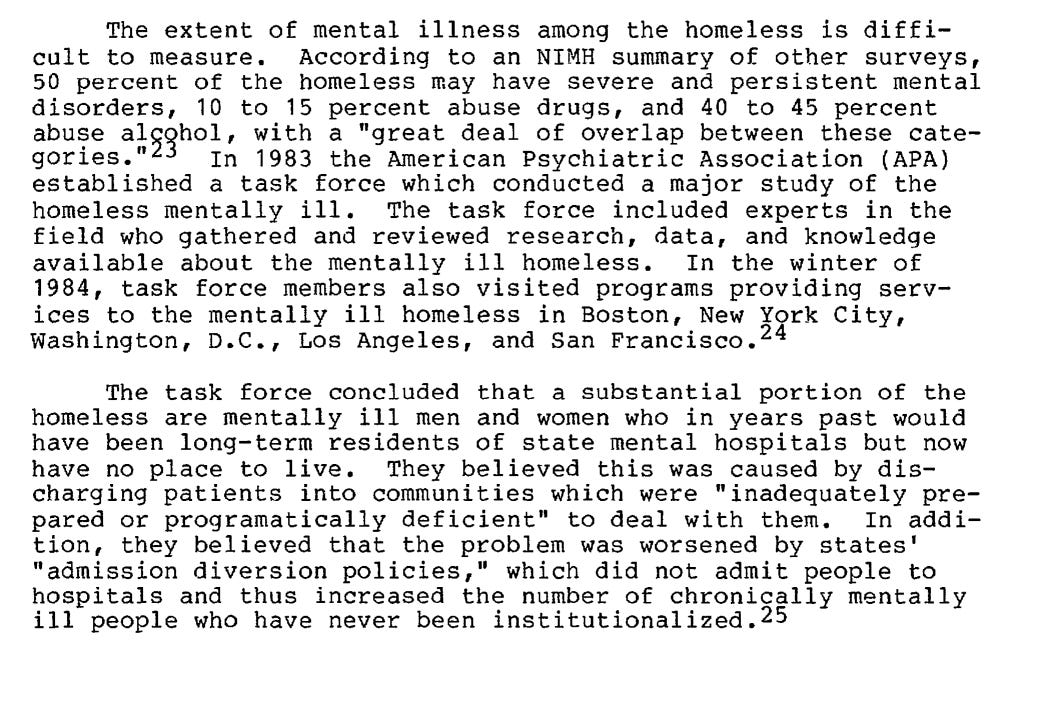
The paper also admits gauging the mental health of the homeless population is difficult, but the two are commonly connected, noting a National Institute of Mental Health (NIMH) survey showing 50 percent of the homeless having severe mental illness as well as high percentages of drug and alcohol abuse. Other common estimates put it at one-third of the homeless having mental health issues.
But deinstitutionalization started in the 1950s and was effectively complete by the mid-1970s following the Medicaid Institution for Mental Diseases (IMD) exclusion in 1965. The IMD exclusion prevented Medicaid from funding inpatient mental health and substance use treatment in residential facilities or psychiatric hospitals that have more than 16 beds, specifically for adults aged 21 through 64.
There were still a few mental institutions being emptied into the 1980s, but before the 1980s homeless crisis. And again, the majority were elderly or female; Not a common population for the homeless or imprisoned with mental health problems, many of whom were younger men with schizophrenia or substance abuse problems.
Instead, it was the economic recessions of the late 1970s and early 1980s that, combined with deinstitutionalization, drove homelessness in the early 1980s. Major psychiatric institutions were no longer there to help shoulder the burden of those suffering from mental health issues as a result of joblessness, homelessness, or any other personal crises.
A 1984 American Psychiatric Association (APA) study showed that “a substantial number of men who in years past would have been long-term residents of state mental hospitals but now have no place to live.” The few community-based care facilities that was ostensibly supposed to replace major psychiatric institutions was ill prepared to handle them, and state hospitals tightened their admittance policies.
Potentially the best description of what happened comes from the book Over the Edge: The Growth of Homelessness in the 1980s. During the 1981 to 1982 recession, soup kitchens and emergency shelters saw the large influx of homeless. Based on estimates from Housing and Urban Development (HUD) in 1984 and one from Burt and Cohen in 1987, homelessness doubled in the span of three years.
Previously, homelessness was largely confined to those who couldn’t afford a roof over their heads and lived in subsidized housing. But the 1980s saw the growth of actual street living. The causes were often a complex portrait of personal strife, financial struggles, mental illness, and drug and alcohol abuse.
The economic downturn with less affordable housing and fewer options for psychiatric treatment or psychiatric stays meant that those on the edge of homelessness and mental health crises were pushed over the edge and wound up on the street.
Good point. I have a relative in NY state who is long-term institutionalized, but is not even legally committed. To me it looks like the only people really turned away are those who are capable of being mentally/physically independent. Such people could do unskilled labor and afford shelter if enough unskilled labor and affordable shelter was available in this economy.