
The current collapse in the Treasury bond market is commonly said to be a remnant of oil prices following the conflict around the Strait of Hormuz.
Bond yields have been intertwined with rising oil prices, and because bond yields are inversely correlated with bond prices, prices for those bonds have collapsed, leading to a collapse in all other bond markets, not just Treasuries.
But that correlation is new. Prior to 2020, oil prices went up and bond yields went down. Something switched in 2020, and that mystery element is the Federal Reserve’s interest rate.
The Federal funds rate is one of the handful of levers the Federal Reserve wields to maintain the economy, like the discount rate, to hinder or unleash inflation. It sets the interest amount that the Fed pays on money lent out to other lending institutions.
And the Fed has been raising interest rates since 2020 in sync with the rising yield and falling price on bonds. Prior to that, interest rates trended downward alongside Treasury yields for decades since the Volcker era of the early eighties. Prior to 1982, they both trended upward.
Yields and interest rates aren’t always exactly in sync. Like after the financial crisis when interest rates were effectively zero and bond yields were in steady decline. But they trend together, and they zig and zag at times of sudden interest rate changes.
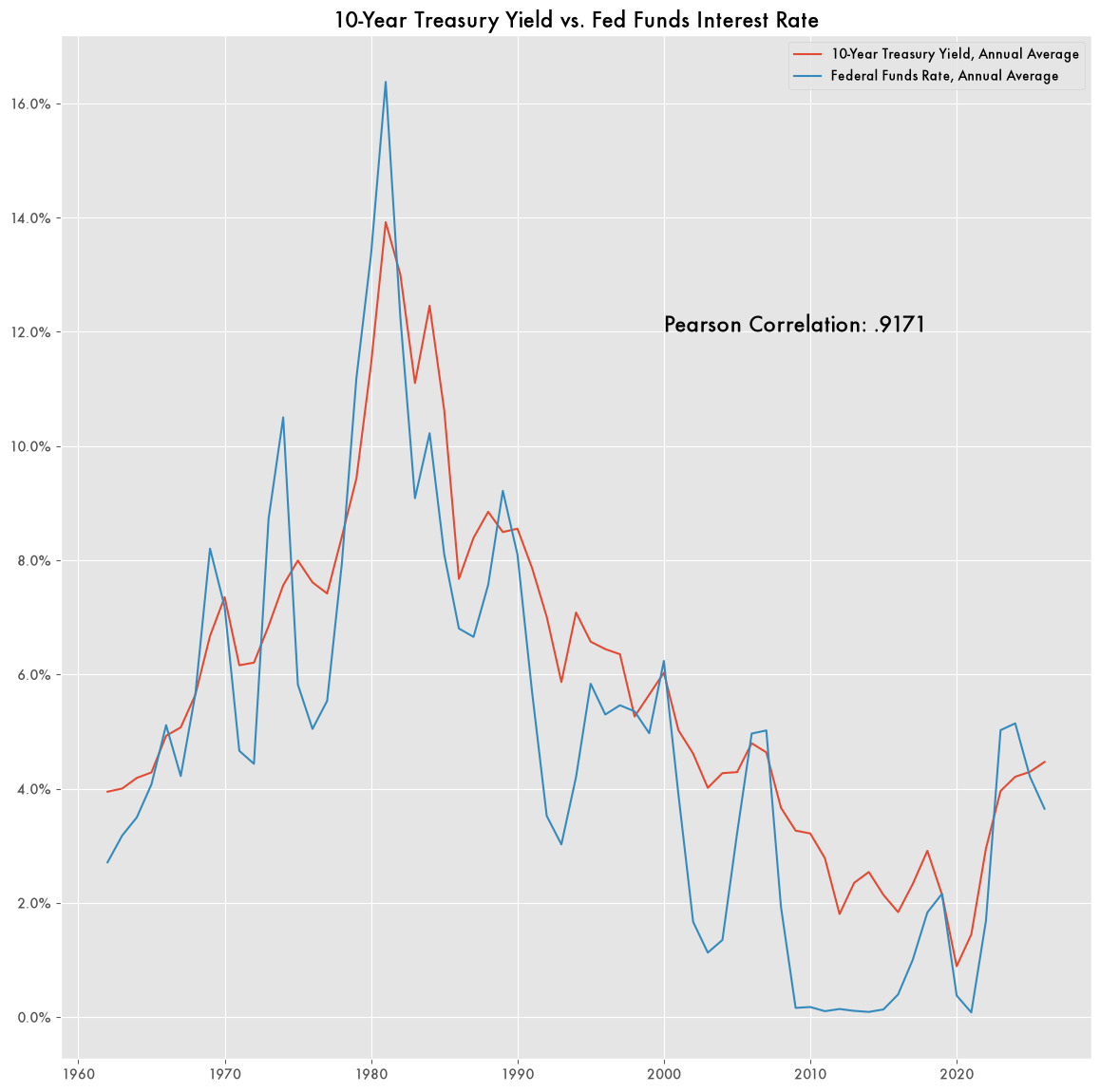
Low Rates Equate To Other Lower Rates
The connection between Treasury yields and interest rates isn’t direct but simply a remnant of how interest rates drive many aspects of the economy.
Federal Reserve interest rates set the amount that investors earn on their deposits at Federal Reserve banks. Those same investors could also be investing in Treasury bonds, and essentially the two products are in competition. If the Treasury needs investors in their bonds, the yields will have to be competitive with the rate they would get by simply parking their money in a Federal Reserve bank overnight—the easiest option for a reliable return.
When bonds are said to follow inflation, there is some truth to that too. Interest rates are often raised to counteract inflation, which would also raise bond yields—potentially what is happening now. But there is no guarantee as it is up to the whims of the head of the Federal Reserve whether or not to raise interest rates.
Whether or not bond prices collapse or not is almost moot considering that it may not be a bad thing for current investors. Low bond prices mean that it costs less to buy a bond that pays out a higher percentage. But it certainly affects current temporary holders of Treasuries trying to sell them at current rates in the secondary market.
For example, China buys lots of Treasuries with money received from trade exports, not for their yield, but as a way to keep their money in dollars, depress the value of the yuan relative to the dollar, and encourage more exports—sometimes referred to as the Export-Treasury Feedback Loop.